05 September 2010

Sep 5

Reference links:
Old Testament

We finish Ecclesiastes today. That was quick!

The bulk of today's reading consists of a listing of various pieces advice. As a fan of diversifying your investments, my favorite is this:
Send your grain across the seas,
and in time, profits will flow back to you.
But divide your investments among many places,
for you do not know what risks might lie ahead.
Ruminations on youth and old age follow the words of advice. The old receive the advice to enjoy each remaining day, even while remembering that all is meaningless. Youths receive the advice to enjoy their youth, avoid worry, and keep their body healthy, but again, also remember that the life before them is meaningless. The teacher then advises youths not to forget their creator, especially as their bodies crumble with age.

After that section, we have some postscripts added by one or more later editors. These are reflections on the words of the teacher. The very last statement seems aimed at trying to advise people not to get the "wrong" idea from this book:
That’s the whole story. Here now is my final conclusion: Fear God and obey his commands, for this is everyone’s duty. God will judge us for everything we do, including every secret thing, whether good or bad.
I cannot help but see this as using a finger to stop up a leaking dam.

Overall, I very much enjoyed Ecclesiastes. It contained something of a almost randomly varied assortment of ideas and forms, but it was interesting. And that is certainly a lot more than most of the Bible can say for itself.

New Testament

Paul tries to persuade the Corinthian church to give money to the church in Jerusalem. He is using several standard fundraising techniques.

  • Mention that their peers are giving: Paul points out that the church in Macedonia gave beyond their means
  • Praise their virtues: Paul points out all of the great things about the members of the Corinthian church and implies that giving more would make them even more virtuous
  • Threaten them: Paul claims that he will be comparing their performance to other churches and considers this a test of their love
  • Give an example of someone they admire: Paul points out that their generosity makes them more like Jesus
  • Appeal to responsibility: They already started this process of giving. Therefore, they should finish it.

Paul knew what he was doing when it came to fund raising.

Psalms and Proverbs

The proverbs contain more introductory material. Apparently, we will be reading sayings filled with advice and knowledge.

04 September 2010

Sep 4

Reference links:
Old Testament

Ecclesiastes is very interesting but also very hard to write about. There is just so much going on. It is impossible to comment on everything that is interesting, so I have to choose just one or two things and give a high level scan of the rest.

Today's reading starts out with a listing of proverbs. As with the book of proverbs, some seem good, others impress less.

The passage I found most interesting in today's reading:
So don’t be too good or too wise! Why destroy yourself?  On the other hand, don’t be too wicked either. Don’t be a fool! Why die before your time? Pay attention to these instructions, for anyone who fears God will avoid both extremes
This passage implies that one should not be too wicked. Okay, that's bread and butter wisdom, but it also implies that one should not be too wise. For the author of Ecclesiastes, this seems to tie into the earlier stated idea that wisdom brings sorrow because it reveals how everything is meaningless, but I have a different application for it in this modern world. No one can care about everything. As I read in an unrelated article recently:
Some of us don’t care all of the time, but all of us don’t care some of the time.
In my mind, the modern application of the admonishment against being too wise is summed up by that quote. It is impossible to always care. There is too much to be wise about everything (or even about a significant portion of everything). Trying to do so would lead only to despair. So instead, practice moderation.

After the Teacher rants about the danger of seductive women, he gives this annoying statement:
Only one out of a thousand men is virtuous, but not one woman!
Hmph. I suspect the flaw lies in the Teacher's attitudes towards women, not in the women themselves. The implication that all women ultimately have no virtue is the same attitude that says a women who dresses provocatively was asking to be raped. Or that a Muslim woman who does not cover herself fully is responsible for the actions men take based on their desires. But that's wrong. It's the men's fault if they think of women as nothing more than their bodies. To imply that all women lack virtue because men are sexually attractive to women shows a vast misunderstanding of half of humanity.

Then we have more thoughts on doing one's duty, especially to the king, the honor enjoyed by the wicked and the sorrow suffered by the poor, the importance of punishing crimes quickly, the universality of death, and the lack of honor accorded to wisdom.

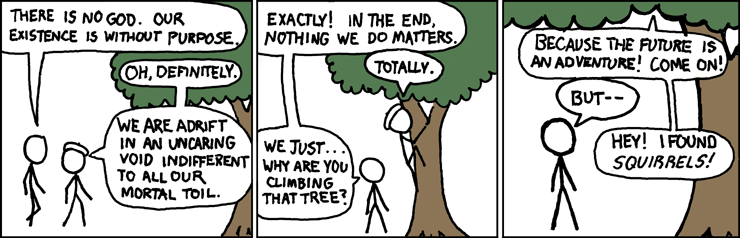
Yet in the midst of all that, the Teacher states once again that it is good to enjoy life. This attitude reminds me of one of my favorite XKCD comics, which I will close with:


New Testament

Paul talks about a harsh letter he sent the Corinthian church and how he is glad it had good effect.

Psalms and Proverbs

Today's proverbs reading seem like the opening to a new section. We are asked to listen to the words of the wise.

03 September 2010

Sep 3

Reference links:
Old Testament

That which is declared meaningless today:

  • Working for success because of envy of others
  • Life without companionship
  • Political power
  • Trying to derive happiness from wealth
  • Hoarding riches and living without enjoying your wealth
  • Fantasizing about what you don't have

Today's list possesses an interesting feature: all of the things on it are things that common wisdom regularly does declare meaningless, or at least not worth the effort they are pursued with. Instead, the author of Ecclesiastes tells people to find companionship, eat, drink, and enjoy the work that they have to do and the wealth that they possess.

The author says to accept your lot in life. I do not interpret that as saying you should not try to change things. Rather, I think that it means to enjoy things in the here and now. What will change will change, but if you keep waiting for change before finding contentment, they you may die without ever finding it.

Really, I do not see why people find Ecclesiastes depressing. I find it to be extremely clear sighted and realistic.

New Testament

Paul cautions believers against pairing themselves with unbelievers. In the process, he implies that we unbelievers are wicked, like the darkness, and of the devil. Paul then goes on to, once again, string together quotations from different parts of the scriptures as if they formed a single continuous passage. I continue to find that dishonest.

Then a bit more about Paul's relationship with the Corinthian church.

Psalms and Proverbs

It'd be nice if this were true, but it clearly isn't.
A person who gets ahead by oppressing the poor
or by showering gifts on the rich will end in poverty.

02 September 2010

Sep 2

Reference links:
Old Testament

We start Ecclesiastes today. As a side note, Psalms and Proverbs fall between Job and Ecclesiastes in the Christian Old Testament.

According to Harris's Understanding the Bible:
The Bible's finest example of skeptical wisdom, the Book of Ecclesiastes is ascribed to King Solomon but is actually the work of an anonymous Israelite sage who calls himself Koheleth (Qoheleth), one who presides over a circle of learners. Delighting in paradox, Koheleth denies the possibility of knowing anything for sure, except the inescapable facts of death and the ultimate futility of all human effort.
... the author of Ecclesiastes adopts an emotionally neutral position of coolly ironic detachment. An aloof observer of human folly, he derives a certain wry amusement from his ivory tower perspective on the human predicament. He is puzzled by Yahweh's apparent unwillingness to enforce ethical principles, but he simply concludes that God chooses to operate with no coherent moral plan -- at least not one that human beings can perceive.
... True wisdom lies in observing everything, knowing how little has genuine value, and refusing to become committed to the hopeless pursuits to which most people blindly devote their lives.  
...The author's love of paradox is a characteristic of the book that troubles some readers; he seldom makes a statement that he does not somewhere else contradict. ... These paradoxic views are among the book's chief strengths, however, for the writer is not contradicting himself, but is asserting that life is too complex for absolute certainties. 
I love it already. =)

On authorship:
Although the superscription to the book attributes its authorship to Koheleth, "son of David, king in Jerusalem" -- presumably Solomon -- most scholars regard this as merely a literary device that offers the writer an elevated position from which imaginatively to experience everything enjoyed by Israel's wealthiest and wisest monarch. 
On date of composition:
Because the author seems familiar with various strands of Greek philosophy, including that of Heraclitus, Zeno the Stoic, and Epicurus, experts end to place the books composition sometime during the Hellenistic era, after the campaigns of Alexander of Macedonia had brought Greek culture to Palestine.  
On to today's content! The opening sets the theme of the book. The author starts by declaring everything to be meaningless. All that seems to be progress is just part of a cycle that repeats again and again.

It is interesting considering passages like this one from the point of view of someone living in the 21st century:
It has all been done before. Nothing under the sun is truly new. Sometimes people say, “Here is something new!” But actually it is old; nothing is ever truly new.
We have truly done new things since this book was composed. We have made so much progress in knowledge and technology. Humanity experienced more change in the 20th century alone than it did in most of history. And yet, the human problems that we encounter are still fundamentally the same.

The author then goes on to consider different ways that one might find meaning in life. He starts with worldly pleasures and finds them to not be worthwhile. Work is futile because all that is earned from it will be left behind when you die. Yet despite that, the author then says,
So I decided there is nothing better than to enjoy food and drink and to find satisfaction in work.
Despite the fact that the pleasures of food and drink and work are futile, the author can find nothing better than to enjoy them. These things can and should be enjoyed despite the fact that they do not give life any ultimate meaning (more thoughts on the idea of meaning later).

After this, we read a poem. Even if you have never read Ecclesiastes, the poem may sound familiar. The poem was made into a hit song by the Byrds in the 1960s.


This is followed by a nice little statement:
I have seen the burden God has placed on us all. Yet God has made everything beautiful for its own time. He has planted eternity in the human heart, but even so, people cannot see the whole scope of God’s work from beginning to end. So I concluded there is nothing better than to be happy and enjoy ourselves as long as we can. And people should eat and drink and enjoy the fruits of their labor, for these are gifts from God.
The author then talks about injustice and death. There is clearly so much to say in this book, and I am clearly not going to be able to say it all. How sad. Maybe I should have skipped most of the deuteronomistic history and just spent time studying this book.

New Testament

Paul continues to talk about himself.

Psalms and Proverbs

Proverbs talks about beating children:
A youngster’s heart is filled with foolishness,
but physical discipline will drive it far away.

01 September 2010

Sep 1

Reference links:
Old Testament

Two thirds done with the Bible, and we finish Job today.

It is something of a let down. After God's first speech, Job humbles himself. After that, we get what seems to be the core God's speech:
Will you discredit my justice
and condemn me just to prove you are right?
Are you as strong as God?
Can you thunder with a voice like his?
That's God's answer? He's powerful? That's it? God's reasoning seems to be that since God is so much more powerful than humans, humans do not have a right to question. They should live a life of passive acceptance. But if we accepted that attitude, we would still believe that God stores the snow and the rain in the storehouses of the heavens, keeps the sea inside its boundaries, and causes the light to appear and depart.

The bulk of the content in today's section of God's speech is God going on about how awesome Behemoth and Leviathan are. After this, Job humbles himself a bit more. God then decides to bless him. The rest of Job's life is happy and prosperous. He even gets 10 new children to replace his old ones (because children are all equivalent, right?).

Before we leave Job, I want to highlight one more bit from the prose epilogue. After Job humbles himself, God says to Eliphaz,
I am angry with you and your two friends, for you have not spoken accurately about me, as my servant Job has.
This could be referring to Job's last two interjections where he humbles himself before God. However, Job did not really say anything in those two interjections. I think it is quite possible (and much more interesting) to understand this as saying that it was Job's challenge that provoked God, not the content of his speeches. Under this interpretation, I take two messages away from Job.

First, reality cannot be denied. No matter how comforting an answer may be, if it does not conform to the data, then it is not the right answer. This may lead you to a place where the only answer you can give is, "I don't know", but that is better than an answer that is simple but wrong.

Second, humanity should not assume it is the center of God's concern. The God of Job delights in the majesty of nature, both animate and inanimate. This is in despite the fact that this majesty may cause harm to humanity.

Earlier I said the theodicy of Job was ultimately unsatisfying. For some, this will be because of the stark picture it paint. I do not mind that. As an atheist, I already possess a world view which accepts the god-free equivalents of the themes above. What makes the theodicy unsatisfying for me is the implication that because the ultimate answer cannot be understood by humans, it is not worth questioning at all. Even if all of the knowledge humanity could acquire is but a speck compared to all the knowledge that exists, it is still worth striving for.

New Testament

Let's start with the opening line of today's reading. From context, it applies to Paul and his fellows. However, it sounds like the type of line that Christians often apply to themselves more generally (many of the bits from this section have that tone). Anywho, on to the line:
Because we understand our fearful responsibility to the Lord, we work hard to persuade others.
From my point of view, this statement does not seem to apply for most nominal Christians. There are people who claim to really and truly believe that some of their loved ones are going to experience an eternity of torture. Yet they don't seem to really mind. I find this bizarre. (And I'm not the only one.)

It the rest of today's reading, Paul states what seem to be some pretty fundamental core beliefs for Christians, but as usual, he just asserts them and makes no attempt to form them into a logical argument. Not that I expect him to formulate his statements as a logical argument when he is writing to fellow believers. Still, for non-believers, it gets tiresome to read baseless assertion after baseless assertion.

Psalms and Proverbs

Nothing of note.