Showing posts with label deuteronomy. Show all posts

10 April 2010

Apr 10

Reference links:
Old Testament

Today we finish Deuteronomy! God shows Moses all of the land that the Israelites are to possess from the top of Mount Nebo. I wonder if there is a mountain you really can see all of ancient Israel from. On the one hand it was relatively small, on the other hand, it was, I believe, larger than modern Israel, and I cannot imagine you see all of that from any mountain.

This passage reminds me of Satan showing Jesus all of the world's kingdoms during Jesus' days in the desert. I wonder if the contrasts in the New Testament story were intentional on the part of the author. When we compare the stories we see lots of opposites: God / Satan; All kingdoms / One kingdom; You can never go there / You can rule over this all.

After Moses sees the promised land, he dies and Joshua takes over leadership of the Israelites. Which brings us to... The Book of Joshua! The Wikipedia article for this book is not as high quality as for the Torah or the gospels we have read so far. However, we do learn the following:
The Book of Joshua has been traditionally ascribed to Joshua himself by early Jewish writers and by the Early Church Fathers. Modern scholars believe that Joshua is the work of writers from the 8th and 7th centuries BC, with retouchings from the exilic period.
Joshua is the first book of the Former (or First) Prophets. Topically, it covers the history of the conquest of the land, the allotment of land to the tribes, and Joshua's farewell address and death. According to Wikipedia, there is no archaeological evidence for a major and abrupt invasion of Canaan by the Israelites.

It sounds like this book will contain a lot of killings and a lot of genocide. I know that some Christians think that genocide is morally acceptable when commanded by God. For the record, I think genocide is reprehensible, and if God is supposedly commanding it, that just reflects badly on his supposedly perfect nature (I suspect I will be making that statement again).

The Book of Joshua starts out with God encouraging Joshua to be a strong and courageous leader. God promises Joshua that,
No one will be able to stand against you as long as you live. For I will be with you as I was with Moses. I will not fail you or abandon you.
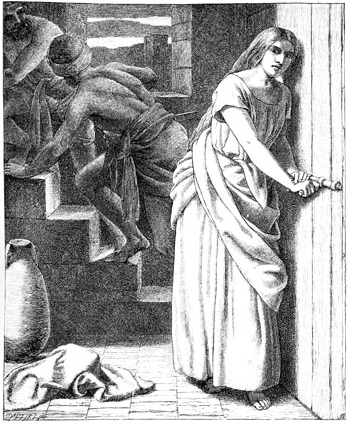

Pickersgill: Rahab Receiveth and Concealeth the Spies

Joshua tells the Israelites to prepare to conquer the promised land. He sends out spies to survey the first city they will attack: Jericho.

Spies provide fodder for a good story in this case. The spies explore the land, but the king of the land hears about them. The spies stay the night at the home of Rahab, a prostitute. Rahab hides the spies and misdirects the men who had come to capture them. In exchange, Rahab asks the spies,
Now swear to me by the Lord that you will be kind to me and my family since I have helped you. Give me some guarantee that when Jericho is conquered, you will let me live, along with my father and mother, my brothers and sisters, and all their families.
 They agree, and she helps them to escape by letting them outside of the city walls with a rope. Exciting!

New Testament

Today Jesus teaches that most people will not get into heaven:
Work hard to enter the narrow door to God’s Kingdom, for many will try to enter but will fail. When the master of the house has locked the door, it will be too late. You will stand outside knocking and pleading, ‘Lord, open the door for us!’ But he will reply, ‘I don’t know you or where you come from.’ Then you will say, ‘But we ate and drank with you, and you taught in our streets.’ And he will reply, ‘I tell you, I don’t know you or where you come from. Get away from me, all you who do evil.’

Slimmer's door, Ringwood Church.

Is it really just for God to build a system where success is so difficult and failure entails eternal torture?

After this we get an interesting statement, seemingly out of no where:
At that time some Pharisees said to him, “Get away from here if you want to live! Herod Antipas wants to kill you!”
I thought the Pharisees wanted to make Jesus trip up? Why are they now warning him about Herod Antipas? Are these different Pharisees? If so, the Pharisees obviously have at least somewhat divided opinions towards Jesus, so why are they so often treated as a single unit elsewhere? Very confusing.

And Jesus healed on the Sabbath more. That's nice of him. (Although I still think that "you would save someone/something from immediate harm on the Sabbath so therefore it is okay to heal chronic diseases on the Sabbath" is an invalid logic, even if I do agree with the conclusion.)

Psalms and Proverbs

Same old, same old.

09 April 2010

Apr 9

Reference links:
Old Testament


Tissot: Moses Blesses Joshua Before the High Priest
Today's reading consists of a poetic blessing from Moses to the people of Israel. The opening declares the people to belong to God; he is their king.

The bulk of the poem consists of blessings for each of the tribes of Israel. I think the value of this passage lies in its enumeration of the different ways God can bless. The assignment of the blessings to the tribes, while certainly significant, seems secondary to shear variety of forms of blessing.

What ways does Moses claim the Lord will bless the Israelites? He will make sure they do not die out. He will give them strength against their enemies and strike down their foes. He will preserve them from harm. He will bless them with abundant crops. He will bless them at home and in their travels. He will enlarge their territory. He will give them security.

The blessings show that for the ancient Israelites, their relationship with God was a two way street, a covenant where both parties had responsibilities. If the Israelites obeyed God's commands, then he would give them very concrete blessings in this life. Such a deal-making God is very different from the more distant and spiritualized God of Christianity.

New Testament


Fugel Gebhard: Pilatus
Today's reading opens with a peculiar statement:
About this time Jesus was informed that Pilate had murdered some people from Galilee as they were offering sacrifices at the Temple.
What is odd about this statement is that there is no further commentary on the murder itself. Instead, the discussion shifts to the topic of guilt and repentance. This statement seems to present an image of Pilate that is unfamiliar. Generally when one thinks of Pilate, one thinks of him in his role of sending Jesus to his death. In that role, he is generally portrayed as having his hands tied. He is portrayed as someone who does not use his power to prevent Jesus' death, but who also should not be actively blamed for Jesus' death. How different that is from the image of Pilate ordering the murder of people as they offered sacrifices.

You may remember from Matthew and Mark how Jesus curses of fig tree because it has not produced fruit. In the earlier versions of the story, Jesus is hungry. He sees a fig tree that is not bearing fruit, and he curses it for its lack of fruit. It then dies. In this fig tree story we read,
Then Jesus told this story: “A man planted a fig tree in his garden and came again and again to see if there was any fruit on it, but he was always disappointed. Finally, he said to his gardener, ‘I’ve waited three years, and there hasn’t been a single fig! Cut it down. It’s just taking up space in the garden.’
“The gardener answered, ‘Sir, give it one more chance. Leave it another year, and I’ll give it special attention and plenty of fertilizer. If we get figs next year, fine. If not, then you can cut it down.’”
This parable only appears in Luke, and the cursing of the fig tree does not appear in Luke. Furthermore, it keeps the element of disappointment in the fig tree's performance. These elements make me think that this might be a the original myth into something that is more inline with the impression Luke wanted to give of Jesus.

Also, mustard seeds and yeast are still like the Kingdom of Heaven.

Psalms and Proverbs

We finish the historical summary psalm (and get a sneak preview of what's to come!). God eventually ends his neglect and chooses David to victoriously rule over the Israelites. Hurrah!

Good proverb today,
Worry weighs a person down;
an encouraging word cheers a person up.

08 April 2010

Apr 8

Reference links:
Old Testament

Today we get the rest of the poem started yesterday. As I am still not in the mood for poetry (I think because I have a slight cold), I do not have anything to say.

New Testament

Today Jesus tells his disciples to always be ready because he may return at anytime. Anytime now. Yup, any minute in the last 2000 years Jesus could have shown up. Any minute now it could happen. Perhaps about 10 minutes after Godot.

We also see this lovely sentiment that we have seen before,

I have come to set the world on fire, and I wish it were already burning! I have a terrible baptism of suffering ahead of me, and I am under a heavy burden until it is accomplished. Do you think I have come to bring peace to the earth? No, I have come to divide people against each other! From now on families will be split apart, three in favor of me, and two against—or two in favor and three against.
The first sentence, which I do not remember seeing in earlier expressions of this sentiment, just make it that much more extreme.

Psalms and Proverbs


Another day of the psalm recounting the history of the Israelites.

07 April 2010

Apr 7

Reference links:
Old Testament

Moses is finally getting around to dying. Now, it is not that I am happy to see Moses die. It is just that he has been on the verge of dying for over a month now. Genesis covered pre-historical mythology plus hundreds of years of history. Exodus covered a good part of the next 40 years. Numbers covered the rest. But part of Numbers, all of Leviticus, and all of Deuteronomy have been covering, in terms of narrative advancement, a matter of weeks, or something along those lines. It's like Zeno's paradox; we keep getting closer and closer to the end, but we will never arrive.

The rest of today's reading includes a statement from Moses that he knows the Israelites will become corrupt sometime after he dies.
Now summon all the elders and officials of your tribes, so that I can speak to them directly and call heaven and earth to witness against them. I know that after my death you will become utterly corrupt and will turn from the way I have commanded you to follow. In the days to come, disaster will come down on you, for you will do what is evil in the Lord’s sight, making him very angry with your actions. 
He then recites a long poem to the same effect (and by long, I mean that it takes up more than half the lines in today's reading and is continued tomorrow).

New Testament

A repeat of the passage that "proves" I shall not be forgiven. Yay blasphemy!
I tell you the truth, everyone who acknowledges me publicly here on earth, the Son of Man will also acknowledge in the presence of God’s angels. But anyone who denies me here on earth will be denied before God’s angels. Anyone who speaks against the Son of Man can be forgiven, but anyone who blasphemes the Holy Spirit will not be forgiven.
Also, a number of lessons about not worrying about money because God will take care of the needs of believers. It is good to encourage people to worry about possessions and status less. However, I feel that these are also lessons that could be used to denigrate the hungry and the homeless and the poor.

Psalms and Proverbs

Today's psalm is a continuation of yesterday's. Today's fragment tells more about ways the Israelites rebelled during their years of wandering. It then reviews the plagues God sent against Egypt as a way of illustrating how forgetful the Israelites are.

Today was definitely not the day to not be in the mood for poetry.

06 April 2010

Apr 6

Reference links:
Old Testament

Obey the covenant, etc., etc. If the Israelites go astray, God will punish them, but if they change and obey him again, he will bless them again. The last paragraph of today's reading summarizes the rest nicely,
Today I have given you the choice between life and death, between blessings and curses. Now I call on heaven and earth to witness the choice you make. Oh, that you would choose life, so that you and your descendants might live! You can make this choice by loving the Lord your God, obeying him, and committing yourself firmly to him. This is the key to your life. And if you love and obey the Lord, you will live long in the land the Lord swore to give your ancestors Abraham, Isaac, and Jacob.

New Testament

In Matthew and Mark, Jesus spent a lot of time criticizing the Pharisees. However, those events always seemed to be in public or in the homes of Jesus' followers. In Luke's version of some of this criticism, Jesus criticizes the Pharisees after one invites him to dinner. That seems rather rude.
As Jesus was speaking, one of the Pharisees invited him home for a meal. So he went in and took his place at the table. His host was amazed to see that he sat down to eat without first performing the hand-washing ceremony required by Jewish custom. Then the Lord said to him, “You Pharisees are so careful to clean the outside of the cup and the dish, but inside you are filthy—full of greed and wickedness! Fools! Didn’t God make the inside as well as the outside? So clean the inside by giving gifts to the poor, and you will be clean all over.
He keeps going on in this vein until he finally leaves,
As Jesus was leaving, the teachers of religious law and the Pharisees became hostile and tried to provoke him with many questions. They wanted to trap him into saying something they could use against him.
I would be annoyed if someone I invited over for dinner started calling me foolish and wicked too.

Psalms and Proverbs

Today's psalm is something different... well, for a psalm. We get part one of a poetic retelling of some of the events that occurred while the Israelites were wandering in the wilderness.

05 April 2010

Apr 5

Reference links:
Old Testament

Today's reading describes the blessings and curses the Israelites will receive if they obey the commands God gave them. It is somewhat telling that the text describing the curses takes up about twice as much space as the space describing the blessings.

Essentially, if the Israelites obey God, he will bless them in everything they do. They will have thriving crops and herds and many children. Rain will come to water the crops. The Israelites will lend to other nations and never borrow. The nations of the world will look upon them with awe. In short, nothing will ever go wrong for them.

On the other hand, if they do not obey the Lord's commands, he will make sure that everything goes wrong. These curses emphasize the point that the Biblical God is not always a God of love and kindness. These curses emphasize the point that it is Biblically invalid to say that good things come from God and bad things come from the Devil. No, in today's reading, the bad things are coming from God quite directly.

To start, everything that was blessed before will be cursed. The Israelites will be frustrated in everything they do, they will lose in battle, their crops and herds will fail, and the skies will yield no rain. Some of the more striking descriptions,
28:20-22: The Lord himself will send on you curses, confusion, and frustration in everything you do, until at last you are completely destroyed for doing evil and abandoning me. The Lord will afflict you with diseases until none of you are left in the land you are about to enter and occupy. The Lord will strike you with wasting diseases, fever, and inflammation, with scorching heat and drought, and with blight and mildew. These disasters will pursue you until you die.
28:29: You will be oppressed and robbed continually, and no one will come to save you.
28:32: You will watch as your sons and daughters are taken away as slaves. Your heart will break for them, but you won’t be able to help them.
28:47-48: If you do not serve the Lord your God with joy and enthusiasm for the abundant benefits you have received, you will serve your enemies whom the Lord will send against you. You will be left hungry, thirsty, naked, and lacking in everything. The Lord will put an iron yoke on your neck, oppressing you harshly until he has destroyed you.
28:53: The siege and terrible distress of the enemy’s attack will be so severe that you will eat the flesh of your own sons and daughters, whom the Lord your God has given you.
28:63: Just as the Lord has found great pleasure in causing you to prosper and multiply, the Lord will find pleasure in destroying you. 
Again, I wonder about those people who can accept both the premise that the God they believe in is a God of love and the premise that the God they believe in is the same as the God of the Old Testament.

New Testament

Jesus explains why it would be silly for him to be casting out demons using power granted by Satan.
Any kingdom divided by civil war is doomed. A family splintered by feuding will fall apart. You say I am empowered by Satan. But if Satan is divided and fighting against himself, how can his kingdom survive? And if I am empowered by Satan, what about your own exorcists? They cast out demons, too, so they will condemn you for what you have said. But if I am casting out demons by the power of God, then the Kingdom of God has arrived among you.
I want to point out to Jesus that while he made a decent appeal as to why he cannot be casting out demons by Satan's power, he has also cast some doubt on his own powers. In particular, by pointing out that random exorcists can cast out demons, he makes his own ability to do so less special.

Psalms and Proverbs

Another psalm along the lines of "God has abandoned me, it's so terrible. But God is wonderful because he did all sorts of wonderful things in the distant past."

04 April 2010

Apr 4

Reference links:
Old Testament

Wow, the author of Deuteronomy managed to fit a mini-recap into a discussion of offering a portion of the first harvest of the year. I am impressed. When these first fruits are offered, the one giving the offering is supposed to give a very terse summary of how God made Jacob prosper and eventually the Israelites ended up in Israel.

Every third year, a special tithe of the crops must be given to the Levites, foreigners, orphans, and widows. That's nice. I think it is good to help those in need, and I think that it is good to have giving be systematic (whether through a religious/governmental system as for the Israelites or with a personal system). In my experience, regularly scheduled giving, whether it's an hour a week or $5000 a year, tends to be less likely to be forgotten and, therefore, has a larger impact in the long run.

After that, Moses instructs the Israelites about the blessings and curses they are to give once they reach the promised land. Once they cross the Jordan, they are supposed to set up some stones as an altar at Mount Ebal and cover them with plaster. Some of the tribes give curses and others blessings. Then the Levites tell the people of Israel a bunch of things that will cause them to be cursed.
  • Creating idols
  • Dishonoring parents
  • Stealing property by moving a boundary marker
  • Leading a blind person astray on the road
  • Denying justice to foreigners, orphans, or widows
  • Having sexual intercourse with any of your father's wives
  • Having sex with an animal
  • Having sex with your sister
  • Having sex with your mother-in-law
  • Attacking a neighbor in secret
  • Accepting payment to kill an innocent person
  • Not affirming and obeying these instructions
The list seems like a random subset of various regulations we have seen before.


New Testament

Jesus visits two sisters, Mary and Martha. When Martha complains that Mary is just sitting listening to Jesus while Martha preps dinner, Jesus remarks that Martha is worrying over details and Mary has found the truly meaningful thing. I agree with the lesson that it is too easy to get caught up in the concerns of day-to-day life and miss out on what is important. On the other hand, knowing how people react under stress, I doubt Martha got much out of the lesson at the time.

The rest of today's reading is about prayer. Apparently, the key to getting God to answer your prayers is to keep asking until he gets annoyed.
Then, teaching them more about prayer, he used this story: “Suppose you went to a friend’s house at midnight, wanting to borrow three loaves of bread. You say to him, ‘A friend of mine has just arrived for a visit, and I have nothing for him to eat.’ And suppose he calls out from his bedroom, ‘Don’t bother me. The door is locked for the night, and my family and I are all in bed. I can’t help you.’ But I tell you this—though he won’t do it for friendship’s sake, if you keep knocking long enough, he will get up and give you whatever you need because of your shameless persistence.
“And so I tell you, keep on asking, and you will receive what you ask for. Keep on seeking, and you will find. Keep on knocking, and the door will be opened to you. For everyone who asks, receives. Everyone who seeks, finds. And to everyone who knocks, the door will be opened.
I actually am kind of surprised that Jesus is so blatant about the fact that bugging God until he gives in is a valid prayer technique. Seeing the second passage in context also shows how many people, Christians and atheists alike, often take that passage out of context. I almost never see anyone mention the requirement for persistence when they mention the second part.

The next passage is also rather well known.
“You fathers—if your children ask for a fish, do you give them a snake instead? Or if they ask for an egg, do you give them a scorpion? Of course not! So if you sinful people know how to give good gifts to your children, how much more will your heavenly Father give the Holy Spirit to those who ask him.
To this I respond: Would you put your children in a room full of knives? Would you leave them alone with a lion? Well then, what are we to think of a God who creates a world where earthquakes and natural disasters kill so many people? What are we to think of a God who could banish all natural disease but will not? You may say that the world is fallen, but natural causes of so much human suffering can certainly not be part of a reasonable punishment for human sin.

Psalms and Proverbs
At the blast of your breath, O God of Jacob,
their horses and chariots lay still.
The images that came to my mind upon reading this were dragon-like fire or garlic breath.

Also interseting,
Human defiance only enhances your glory,
for you use it as a weapon.
So you see, atheists are helping God.

Two good proverbs today and one nearly tautalogical one. Can you figure out which is which?
Fools think their own way is right,
but the wise listen to others.

A fool is quick-tempered,
but a wise person stays calm when insulted.

An honest witness tells the truth;
a false witness tells lies.

03 April 2010

Apr 3

Reference links:
Old Testament

Today's reading may win the prize for the most downright factual section title. Actually, a quick aside on section titles. They were not part of the original text, and I find them to be rather distracting. They often imply how a passage should be interpreted, which I feel biases my reading. But the section title today just pointed out an inescapable fact about today's reading: it is full of "Miscellaneous Regulations".

There are way too many regulations to call out individual to deal with them individually, but I will point out the most interesting ones. Right off the bat, first sentence of the reading, we get,
If a man’s testicles are crushed or his penis is cut off, he may not be admitted to the assembly of the Lord.
Fortunately, as a woman, I do not cringe the way that I guess some of my more masculine readers do when reading such a passage. In any case, this regulation does not seem particularly fair, especially since I am guessing most of those men did not choose to end up in that particular state of injuries.

Much more fair is this regulation on slavery,
If slaves should escape from their masters and take refuge with you, you must not hand them over to their masters. Let them live among you in any town they choose, and do not oppress them.
I rather like this next regulation,
A newly married man must not be drafted into the army or be given any other official responsibilities. He must be free to spend one year at home, bringing happiness to the wife he has married.
Also, to come full circle, anatomically,
If two Israelite men get into a fight and the wife of one tries to rescue her husband by grabbing the testicles of the other man, you must cut off her hand. Show her no pity.
The punishment seems rather extreme, but I do agree that grabbing a man's testicles should not be considered a reasonable way to help your husband.

On a high level, it seems like the regulations have two main concerns: purity and fairness. These can be further divided into sexual purity and sanitary purity on the one hand and mercy and justice on the other hand. Now, this may not be a complete categorization, but it helps me understand why some of the regulations seem more relevant than others.

The purity regulations, by and large, do not seem particularly interesting. The sexual purity laws seem kind of silly. The sanitary purity laws just seem like common sense.

The fairness laws are more interesting. The justice laws seem harsh, centered around the "eye for an eye" mentality. These laws seem to be focused on making sure the Israelites fear doing wrong (such as yesterday's regulation that a disobedient son should be stoned). The mercy laws, on the other hand, are rather appealing, and formalized mercy seems like something that we could use more of.

Finaly, today's reading once again maligns poor Balaam's reputation.
Instead, they [the Moabites] hired Balaam son of Beor from Pethor in distant Aram-naharaim to curse you. But the Lord your God refused to listen to Balaam. He turned the intended curse into a blessing because the Lord your God loves you.
Now, when we read that story before, it seemed that Balaam was pretty willing to go along with God's will, whatever that ended up being. He did not seem to particularly want to curse the Israelites. Poor Balaam.

New Testament

Today we are continuing on with the theme of "people who reject Jesus and his disciples will suffer". I am rather perplexed by one of the examples,
And you people of Capernaum, will you be honored in heaven? No, you will go down to the place of the dead.
Wait, isn't Capernaum the place where Jesus taught regularly and healed many and healed the servant of the Roman officer? If it was actually such a terrible place, why was that not mentioned any of the times that Jesus' visits to Capernaum were actually being described?

Jesus thanks God for hiding the truth from those who think themselves wise and clever and revealing it to the childlike. I cannot really understand a mindset that thinks that the truth is something to be hidden, that the truth should only be revealed to those who somehow deserve it. Since I cannot understand such a view point, to me Jesus' prayer just sounds petty, "Nya, nya! I don't like you, so God does not reveal the truth to you."

Today we read the story of the Good Samaritan (apparently, only in Luke). This is one of those stories that contains a good life lesson completely independent of Jesus' divinity or existence. The setup for this story is a that an expert in religious law asked Jesus which was the most important commandment. Jesus reflects the question back and the man replies that the most important commandments are,

You must love the Lord your God with all your heart, all your soul, all your strength, and all your mind.’ And, ‘Love your neighbor as yourself.
This part of the story bears a non-trivial resemblance to stories in Matthew and Mark. The man asks, "And who is my neighbor?" Jesus responds with the story of the Good Samaritan. A Jewish man was injured by the side of the road. A priest and a temple assistant both walked by and ignored him, but a detested Samaritan came and cared for the injured man. The lesson of this story is that everyone is your neighbor, and so you should show love to everyone.


Psalms and Proverbs

Today's psalm is a psalm of praise. This stands in start contrast to yesterday's psalm, which was all about God's rejection. On the one hand, I know that I should not read a collection of poetry as a coherent narrative. On the other hand, it is sometimes difficult to get my head around the day-to-day mood swings.

But then, I would rather have variety than not. Today's proverbs continue the theme of praising the godly and condemning the wicked.

02 April 2010

Apr 2

Reference links:
Old Testament

Back to our regularly scheduled skepticism! Somebody commented on my Google Buzz for yesterday's entry and seemed to take it seriously. Ooops!

Today we get a laundry list of regulations. Hurrah! Or something like that. We get off to an exciting start.
When you are in the land the Lord your God is giving you, someone may be found murdered in a field, and you don’t know who committed the murder.
The rest is not nearly exciting. The elders of the nearest town have to break the neck of a young cow to cleanse the guilt of murder from the community. I suppose it is symbolic cleansing, because I do not see how killing a cow actually makes anything better.

Quick commentary on the interesting regulations.

And suppose you see among the captives a beautiful woman, and you are attracted to her and want to marry her. If this happens, you may take her to your home, where she must shave her head, cut her nails, and change the clothes she was wearing when she was captured. She will stay in your home, but let her mourn for her father and mother for a full month. Then you may marry her, and you will be her husband and she will be your wife.
The woman, as far as I can tell, gets no say in the matter.

Suppose a man has two wives, but he loves one and not the other, and both have given him sons. And suppose the firstborn son is the son of the wife he does not love. When the man divides his inheritance, he may not give the larger inheritance to his younger son, the son of the wife he loves, as if he were the firstborn son.
Fair enough.

Suppose a man has a stubborn and rebellious son who will not obey his father or mother, even though they discipline him. ... Then all the men of his town must stone him to death. In this way, you will purge this evil from among you, and all Israel will hear about it and be afraid.
Okay, stoning is totally not an acceptable form of punishment for rebellious children.

A woman must not put on men’s clothing, and a man must not wear women’s clothing. Anyone who does this is detestable in the sight of the Lord your God.
Do jeans and a button down shirt count  as men's clothing? And I do sometimes steal my husband's jeans. Hmmm, God must hate me.

Also,

  • Be socially responsible and help your neighbors when they are in trouble or have lost something
  • Do not eat a mother bird with chicks or eggs (the chicks and eggs can be eaten though)
  • Put railings around flat roofs
  • Don't plant anything with your grapes
  • Do not harness oxen with donkeys
  • Do not wear clothing made of wool and linen
  • Put tassels on your clothing
  • If a man accuses a woman of not being a virgin when they marry, he is fined and punished if he is wrong. She is stoned if he is right (or rather, she is stoned if her parents cannot prove he is wrong)
  • Adulterers must be killed
  • If a man has sex with an engaged woman they must be stoned
  • But if a man rapes an engaged woman out in the country, it is assumed that she screamed for help so only he is stoned
  • If a man has sex with a woman who is not engaged, he must marry her. There is no comment on whether or not it makes a difference if the the sex was forced.
  • A man must not marry his father's former wife

New Testament

Today we get a random story that I do not remember being in Matthew or Mark:
As the time drew near for him to ascend to heaven, Jesus resolutely set out for Jerusalem. He sent messengers ahead to a Samaritan village to prepare for his arrival. But the people of the village did not welcome Jesus because he was on his way to Jerusalem. When James and John saw this, they said to Jesus, “Lord, should we call down fire from heaven to burn them up?” But Jesus turned and rebuked them. So they went on to another village.
What a weird story! What did the villagers have against Jesus going to Jerusalem? Did James and John really think they could call fire down from heaven? Were they really willing to do so over something like this? What's the point of this story?

Jesus tells people that the cost of following him is that they must turn their backs on their friends and family, without saying goodbye. If this is meant purely as a metaphor, then we can understand it as making a new beginning, breaking from the past, etc. If Jesus was actually telling people they could not bury their parents or say goodbye to their families, he was a jerk,

We also read today about how Jesus sent out his disciples. You may be wondering, "Didn't we just read about that a couple days ago?" You are right! Kind of. In Luke 10:1-6 we read about how Jesus sent out the 12, telling them to carry nothing with them. This is also similar to Matthew and Mark's versions. However, today's version is different because Jesus sent out 72 disciples in pairs to preach.

Psalms and Proverbs

Today's psalm is all about how the psalmist feels that the Israelites have been rejected by God. Maybe, Mr. Psalmist, the real problem is that this God you have heard about never did exist and all of those accounts of past miraculous signs are stories and rationalization of past events.

01 April 2010

Apr 1

Reference links:
Thank God for the glory of his grace! I realized that I was the wicked sinner today's readings were describing. Once I admitted that, the power of the Holy Spirit flowed over me, and I welcomed Jesus Christ into my heart as my one true Lord and Savior! God's word spoke to me!
For example, never sacrifice your son or daughter as a burnt offering. And do not let your people practice fortune-telling, or use sorcery, or interpret omens, or engage in witchcraft, or cast spells, or function as mediums or psychics, or call forth the spirits of the dead. Anyone who does these things is detestable to the Lord.
This is me! How many times have I wanted to practice fortune telling and use sorcery. I have tried in vain to cast spells and call forth the spirit of the dead! I have longed to have a child that I could sacrifice to the modern pagan God of abortion! I am this sinner!

I have let false prophets live. I have seen them make their failed prophecies and not rebuked them. I have been against war when my Lord teaches that war is just when it is waged in his holy name. I have cried out for justice for our prisoners of war, when my Lord teaches their complete destruction. My sins have been great!

Oh, how today's psalm speaks to me!
But as for me, I almost lost my footing.
My feet were slipping, and I was almost gone.
For I envied the proud
when I saw them prosper despite their wickedness.
They seem to live such painless lives;
their bodies are so healthy and strong.
They don’t have troubles like other people;
they’re not plagued with problems like everyone else.
They wear pride like a jeweled necklace
and clothe themselves with cruelty.
These fat cats have everything
their hearts could ever wish for!
They scoff and speak only evil;
in their pride they seek to crush others.
That was me! Everything I have done, everything I have said up to this point in my life was evil. All of my prosperity, health, and happiness was nothing but sin! And for those things I was willing to give up my eternal salvation!
The godly care for their animals,
but the wicked are always cruel.
I was always cruel, but now, with the power of Jesus, I can be kind to animals. Oh Lord! Without you, I always wanted to wring their little necks. But now, through your grace and mercy, I know that I should care for them. Thank you Lord for this revelation!

I know that many of you reading this are wicked fools like I once was. I beg you today to let Jesus heal you, just as he healed the boy possessed by demons. I beg you to welcome Jesus into your heart like a little child! The Bible says that Jesus is God's son, his Chosen One. Believe it!

31 March 2010

Mar 31

Reference links:
Old Testament

Today we read, yet again, about the three major festivals: Passover, the Festival of Harvest, and the Festival of Shelters. Since Passover started recently, the information is, at least, timely.

I rather like that the other two major festivals are focused on celebration. For the Festival of Harvest:
Celebrate with your sons and daughters, your male and female servants, the Levites from your towns, and the foreigners, orphans, and widows who live among you.
and for the Festival of Shelters:
This festival will be a happy time of celebrating with your sons and daughters, your male and female servants, and the Levites, foreigners, orphans, and widows from your towns. ... This festival will be a time of great joy for all.
Next we read some legal miscellany. The Israelites should appoint judges over the people. The text recognizes that even a wise judge would be led astray by bribes, and so judges should not accept bribes. Nothing is said about what would happen if a judge did accept bribes.
Never accept a bribe, for bribes blind the eyes of the wise and corrupt the decisions of the godly.
The decrees of the judges are final. Anyone who disputes the decrees of the judges must be put to death.
Anyone arrogant enough to reject the verdict of the judge or of the priest who represents the Lord your God must die. In this way you will purge the evil from Israel. Then everyone else will hear about it and be afraid to act so arrogantly.
I find the reasoning behind this interesting. The purpose behind killing those who dispute a judge's ruling is to inspire fear. I suppose, in some sense, all legal systems are based on fear (of punishment, ostracism, inability to access resources, etc.), but I think I still prefer systems where the primary basis of the system is principle, not fear.

Finally, we read the guidelines that a king must follow, if the Israelites ever decide that they want a king. This is another one of those passages that reads differently depending on whether you believe it was composed before or after Israel started having kings.

New Testament

I found this passage from today's reading hilarious. I think because my brain seized on the word "puzzled", so I read it in a perplexed voice.
When Herod Antipas, the ruler of Galilee, heard about everything Jesus was doing, he was puzzled. Some were saying that John the Baptist had been raised from the dead. Others thought Jesus was Elijah or one of the other prophets risen from the dead.
“I beheaded John,” Herod said, “so who is this man about whom I hear such stories?” And he kept trying to see him.
Beyond that, more repeats. Jesus feeds 5000 with five loaves of bread and two fish, Peter declares Jesus to be the Messiah, and Jesus predicts his death and resurrection.

Psalms and Proverbs

Kings have not been much of a topic in our readings so far, which makes today's readings stick out. As I mentioned, we read about guidelines a king must follow in Deuteronomy. In today's psalm we read of a king asking for God's blessing and guidance.

30 March 2010

Mar 30

Reference links:
Old Testament

God likes to test the Israelites every once in awhile just to see if they really love him. He must have self esteem issues.
If they then say, ‘Come, let us worship other gods’—gods you have not known before— do not listen to them. The Lord your God is testing you to see if you truly love him with all your heart and soul [physical and mental self].
God also has a zero tolerance policy towards those who try to entice the Israelites away from God.
Suppose someone secretly entices you—even your brother, your son or daughter, your beloved wife, or your closest friend—and says, ‘Let us go worship other gods’—gods that neither you nor your ancestors have known. They might suggest that you worship the gods of peoples who live nearby or who come from the ends of the earth. But do not give in or listen. Have no pity, and do not spare or protect them. You must put them to death! Strike the first blow yourself, and then all the people must join in.
And it sucks to be anyone who lives in a town where some people have gone astray.
If you find that the report is true and such a detestable act has been committed among you, you must attack that town and completely destroy all its inhabitants, as well as all the livestock. Then you must pile all the plunder in the middle of the open square and burn it. Burn the entire town as a burnt offering to the Lord your God. That town must remain a ruin forever; it may never be rebuilt.
If people in a town have actually been tempted away from God, the whole town must be destroyed? Remember, these are allegedly God's direct commands, and so, in my opinion, it is perfectly reasonable to apply modern standards to them. By any reasonable modern standards of morality, this is horrendous.

After that we get a description of which animals are clean or unclean. We also get discussions of tithing, the forgiving of debts every seventh year, the release of Hebrew slaves every seventh year, and God's dislike of imperfect animals. Much of this we have heard before. Repetition can be useful for learning, but I still wonder how short the Torah would be if all the repetition were removed. Half the size?

New Testament

Speaking of repetition, today we read the story of the woman who had been bleeding for 12 years and was healed when she touched Jesus' robe. We also read that Jesus raised Jairus' daughter from death. Finally, we read about how Jesus sent out his disciples to teach and heal. All things we have read before.

Psalms and Proverbs

Nothing of note today.

29 March 2010

Mar 29

Reference links:
Old Testament

Gah, it's late! So only highlights tonight.
Keep in mind that I am not talking now to your children, who have never experienced the discipline of the Lord your God or seen his greatness and his strong hand and powerful arm. They didn’t see the miraculous signs and wonders he performed in Egypt against Pharaoh and all his land. They didn’t see what the Lord did to the armies of Egypt and to their horses and chariots—how he drowned them in the Red Sea as they were chasing you. He destroyed them, and they have not recovered to this very day!
“Your children didn’t see how the Lord cared for you in the wilderness until you arrived here. They didn’t see what he did to Dathan and Abiram (the sons of Eliab, a descendant of Reuben) when the earth opened its mouth in the Israelite camp and swallowed them, along with their households and tents and every living thing that belonged to them. But you have seen the Lord perform all these mighty deeds with your own eyes!
I suppose part of the population may have seen these things as children, but God's sentence of 40 years wandering plus multiple killing sprees killed off most of the population that would have seen all these things.
Rather, the land you will soon take over is a land of hills and valleys with plenty of rain
Sadly, extensive droughts are a problem for modern Israel. I know that the climate has changed in that region over the times spanned by human civilization. I wonder if it was significantly different in the time of the ancient Israelites.
Your pattern of worship will change. Today all of you are doing as you please, because you have not yet arrived at the place of rest, ... When he gives you rest from all your enemies and you’re living safely in the land, you must bring everything I command you ... to the designated place of worship, the place the Lord your God chooses for his name to be honored. ... Be careful not to sacrifice your burnt offerings just anywhere you like. You may do so only at the place the Lord will choose within one of your tribal territories. There you must offer your burnt offerings and do everything I command you.
This passage confuses me. Didn't we read extensive passages in Exodus about the building of the Tabernacle? Wasn't that supposed to be the place all the sacrifices were performed? That sure does not sound like sacrificing burnt offerings "anywhere you like". I seem to even remember some passages to the effect that sacrifices could only be made by the priests at the altar, although I cannot remember them now.

New Testament

Jesus calms a storm. Jesus heals the man filled with many demons and sends them into a herd of pigs.

Psalms and Proverbs

Nothing of note in today's psalm. However, we do learn from Proverbs:
A worthy wife is a crown for her husband,
but a disgraceful woman is like cancer in his bones.
I somehow feel that "cancer" must be a pretty liberal translation of whatever the original Hebrew said. Seeing as, you know, its designation as such is fairly modern.

28 March 2010

Mar 28

Reference links:
Old Testament

Today in short: "God tells the Israelites that they suck, but everyone else sucks more."
it is because of the wickedness of the other nations that he [God] is pushing them out of your way. It is not because you are so good or have such integrity that you are about to occupy their land. The Lord your God will drive these nations out ahead of you only because of their wickedness, and to fulfille the oath he swore to your ancestors Abraham, Isaac, and Jacob. You must recognize that the Lord your God is not giving you this good land because you are good, for you are not -- you are a stubborn people.
Moses recaps the golden calf incident to illustrate the stubbornness of the Israelites. He makes it clear that the Israelites forced him to endure enourmous hardships and trouble.

After telling the Israelites how much trouble they are, Moses beseaches them to change their ways.
And now, Israel, what does the Lord your God require of you? He requires only that you fear the Lord your God, and live in a way that pleases him, and love him and serve him with all your heart and soul. And you must always obey the Lord's commands and decrees that I am giving you today for your own good.
Obeying a yet unspecified set of commands and decrees seems a lot to sweep under the word "only". However, maybe this is meant to be read as two parts. First, God requires the Israelites to love him and serve him and live lives that please him. Separately, God gives the Israelites the decrees for their own good. Only the first set are general requirements from God. The second set are contextually generated requirements.

One of the interesting things about Deuteronomy ?:12-22 is that it is the first bit of Old Testament we have read in awhile that really fits what seems to be the contemporary Christian view of God. God is described thusly,
He is the great God, the mighty and awesome God, who shows no partiality and cannot be bribed. He ensures that orphans and widows receive justice. He shows love to foreigners living among you and gives them food and clothing.
That said, I am hard pressed to see how a God who has a chosen people shows no partiality.

New Testament

The parable of the farmer scattering seed! You knew we had to get here again sometime. We saw this parable in both Matthew and Mark. Jesus tells the same story, but his explanation differs in a small but, for me, vital way.

To review: a farmer throws seed on the ground. Birds eat some, some sprout and whither, thorns choke and crowd others, and some grow and thrive. Jesus reveals the meaning of this parable: The seeds taken by birds represent people who are kept from God's word by the devil. The seeds that whither up represent those who believe for awhile and then fall out of belief. The plants that were choked to death represent the people whose reception of God's word is pushed out by the world, but here is where the difference comes in. In Mark we read (Matthew is nearly identical):
The seed that fell among the thorns represents others who hear God’s word, but all too quickly the message is crowded out by the worries of this life, the lure of wealth, and the desire for other things, so no fruit is produced.
But in Luke we read
The seeds that fell among the thorns represent those who hear the message, but all too quickly the message is crowded out by the cares and riches and pleasures of this life. And so they never grow into maturity.
Saying "no fruit is produced" has pretty much the same meaning as "never grow into maturity", but for some reason, the second phrasing made me think about the passage differently. Unlike the first two types seed which die off, this type of seed does grow, but it never reaches the point of maturity. However, it does stay alive, so is, in some respects, successful. Applied to a person, it seems to me like this group of seeds describes people who complacently think that they are living the life called for by their faith, but they are not actually doing so. To not comment on modern issues, probably most Christians in the US today are represented by this third category of seed.

Today's reading also talks about how you do not light lamps just to cover them up and so, similarly all that is secret will eventually be brought to life. It also contains the vingette about Jesus' true mother and brothers: When Jesus' mothers and brothers come to him, he declares that those who hear and accept God's word are his real mother and brothers. I still cannot read that story without thinking that it is concealing some deep family tensions.

Psalms and Proverbs

When I predicted yesterday what today's reading from the Psalms would be like, I predicted that today's completion of yesterday's psalm would describe how God eventually did save the psalmist from the hardships he suffered. I was wrong in detail, right in general gist. Instead, what today's reading contains is the psalmists declaration of how he will praise God once God does rescue the psalmist.

The first proverb today is almost tautological if you start from the position that God is good
The Lord approves of those who are good,
but he condemns those who plan wickedness.

27 March 2010

Mar 27

Reference links:
Old Testament

Today's reading seems to have these main points.
  • The Israelites have a duty to destroy their enemies because they are God's holy people.
  • For you are a holy people, who belong to the Lord your God. Of all the people on earth, the Lord your God has chosen you to be his own special treasure.
    The Lord did not set his heart on you and choose you because you were more numerous than other nations, for you were the smallest of all nations! Rather, it was simply that the Lord loves you, and he was keeping the oath he had sworn to your ancestors.
  • The Israelites should completely destroy their enemies. Now, while total destruction may have been a rational strategy for the ancient Israelites given the world at that time, it is not an attitude that I can accept in a being worthy of being called God.
  • When the Lord your God hands these nations over to you and you conquer them, you must completely destroy them. Make no treaties with them and show them no mercy.
  • God will bless the Israelites if he obeys them and curse them if they do not. On the one hand, it is reasonable for God to demand something (obedience) in return for what he is giving (prosperity). On the other hand, it provides a useful out for the good and bad that inevitably happens in any society.
  • Be careful to obey all the commands I am giving you today. Then you will live and multiply, and you will enter and occupy the land the Lord swore to give your ancestors. ...
    ... But I assure you of this: If you ever forget the Lord your God and follow other gods, worshiping and bowing down to them, you will certainly be destroyed.
  • Everything God did in the dessert, including nearly starving and dehydrating the Israelites and killing tens of thousands for them was just to prove their character. I did not realize that mass murder was an acceptable way to prove character.
  • Remember how the Lord your God led you through the wilderness for these forty years, humbling you and testing you to prove your character, and to find out whether or not you would obey his commands. Yes, he humbled you by letting you go hungry and then feeding you with manna, a food previously unknown to you and your ancestors. He did it to teach you that people do not live by bread alone; rather, we live by every word that comes from the mouth of the Lord.
New Testament

As I noted when we started reading Luke, one of the themes of Luke is a concern with women. This shows up in today's reading. We read the story of a woman who anointed Jesus with expensive perfume, and we read a list of women who followed Jesus.

With just that summary, you might think that this is the same as the story presented in Matthew and Mark where a woman pours a jar of expensive perfume over Jesus' head shortly before his crucifixion. You may or may not be wrong. In detail, this version is quite different, but just similar enough to make it unclear as to whether or not one or two events were described (or one story grew in two ways).
  • Who: In Matthew and Mark, the anointing was done by woman. In Luke, the woman is specifically an immoral woman.
  • Where: In Matthew and Mark, this occurred at the home of Simon, a former leper. In Luke it occurred at the home of Simon, a Pharisee.
  • What: In Matthew and Mark, the woman came in and poured the perfume over Jesus' head. In Luke, it is Jesus' feet that are anointed with a mixture of an expensive perfume and the woman's tears. In both cases, the perfume was in a "beautiful alabaster jar".
  • The criticism: In Matthew and Mark, the disciples criticize the woman for wasting perfume that could have been sold for money to give to the poor. In Luke, Simon is aghast that Jesus is letting himself be touched by a sinner.
  • The resolution: In Matthew and Mark, Jesus declares that the woman has done a beautiful thing and will be remembered. In Luke, Jesus forgives her sins.
Luke's list of women travelling with Jesus shows that Luke, at least, viewed women as significantly powerful than we might think. Luke also notes that women were supporting Jesus out of their own resources. I do not have the background to know whether or not such activities were radical for the time. If they were, it does a lot to support the argument that Christianity treats women as equals (a view that, as we will see, Paul provides plenty of support against). If such a view was not radical for its time, it shows how much we had regressed before the 20th century women's liberation movements.

Psalms and Proverbs

Today's psalm appears to be another one in the pattern "God has abandoned me. Oh look! Now he's saved me." However, since it is broken over two days of readying, today we only get the part where the psalmist complains about how much he suffers for God and how God seems to have abandoned him. Presumably, tomorrow we will get the part where we hear about how God saved him and is wonderful and what not.

Today's proverb actually seems like a good one,
To learn, you must love discipline;
it is stupid to hate correction.
Learning does requires discipline and being open to acknowledging you are wrong.

26 March 2010

Mar 26

Reference links:
Old Testament

About half of today's reading repeats the 10 commandments. In the preface to that, Moses makes the following declaration,
The Lord our God made a covenant with us at Mount Sinai. The Lord did not make this covenant with our ancestors, but with all of us who are alive today.
This statement implies, or at least possibly implies, that the people receiving this speech are the same as the people who were at Mount Sinai. But this speech is being given after the forty years of wandering, so we know that the people Moses is addressing are nearly a completely different group than before. Maybe the Hebrew phrasing implies distant ancestors?

Getting back to the commandments, this list pretty much provides a straight repeat of the list in Exodus. Since then, I have learned that the use of the word "covet" in the passage below is probably completely wrong,
You must not covet your neighbor’s wife. You must not covet your neighbor’s house or land, male or female servant, ox or donkey, or anything else that belongs to your neighbor.
The word translated as covet probably means "take." It seems to be a word for taking that had certain unrecoverable implications, but still, analyzing the Hebrew in context makes for a fairly strong case that it is an action that is being condemned, not thought crime.

The other half of today's reading contains an admonition to the Israelites to remember the Lord's commands and live a life faithful to his will. This passage summarizes as good as any,
Listen, O Israel! The Lord is our God, the Lord alone. And you must love the Lord your God with all your heart, all your soul, and all your strength. And you must commit yourselves wholeheartedly to these commands that I am giving you today. Repeat them again and again to your children.
This part of the reading describes the land God is giving to the Israelites,
It is a land with large, prosperous cities that you did not build. The houses will be richly stocked with goods you did not produce. You will draw water from cisterns you did not dig, and you will eat from vineyards and olive trees you did not plant.
As I read that I could not help but think, "You know, that is not exactly something I would go around bragging about."

New Testament

Today's reading relates the story of Jesus raising a widow's son from the dead. The Wikipedia article on Jesus' miracles points out, that three of the gospels have stories of Jesus raising someone from the dead, but all of the stories are quite different. Given that descriptions of other miracles seem to overlap a lot, this makes me wonder if, by the time the gospels were written, there was a tradition of Jesus having the power to raise the dead, but there was no single story commonly associated with that miracle. Thus, each gospel author either drew from a different tradition or made up their own story to work in that aspect of Jesus' power.

In other news, Jesus more or less tells John the Baptist,  "Yes, I am the the Messiah."

Psalms and Proverbs

Today's reading from the psalms has some rather icky imagery.
But God will smash the heads of his enemies,
crushing the skulls of those who love their guilty ways.
and
You, my people, will wash your feet in their blood,
and even your dogs will get their share!”
I feel like the first two of today's proverbs must have lost something in translation.
Those who bring trouble on their families inherit the wind.
The fool will be a servant to the wise.
The seeds of good deeds become a tree of life;
a wise person wins friends.
Neither quite makes sense as a two line unit.

25 March 2010

Mar 25

Reference links:
Old Testament

Moses sets a high standard for the decrees and regulations that God gives the Israelites.
Obey them completely, and you will display your wisdom and intelligence among the surrounding nations. When they hear all these decrees, they will exclaim, ‘How wise and prudent are the people of this great nation!’ For what great nation has a god as near to them as the Lord our God is near to us whenever we call on him? And what great nation has decrees and regulations as righteous and fair as this body of instructions that I am giving you today?
Therefore, as we read these laws and decrees, we should remember that they are supposed to seem wise and prudent to people outside the Israelite community, so we should feel free to judge them by that standard. The standards of surrounding nations are not exactly the standard of modern America, but we do know that these laws were expected to stand up to some external evaluation.

In today's reading, Moses lays out what will happen to the Israelites if they do not keep their covenant.
If you break my covenant, you will quickly disappear from the land you are crossing the Jordan to occupy. You will live there only a short time; then you will be utterly destroyed. For the Lord will scatter you among the nations, where only a few of you will survive. There, in a foreign land, you will worship idols made from wood and stone—gods that neither see nor hear nor eat nor smell. But from there you will search again for the Lord your God. And if you search for him with all your heart and soul, you will find him.
The main thing I want to point out about this passage is the use of the phrase "heart and soul". Looking at a concordance, we see that this passage actually uses the words לבב (levav) and נפש (nefesh) . As I discussed several days ago, the translation "heart and soul" is rather terrible. The true sense of this phrase is more like "everything intangible about yourself and everything tangible about yourself". In particular, the passage makes no commitment to the abstract idea of a soul.

Today's reading also emphasizes the point that the God of the Hebrews is the only God and that the Israelites are pretty special to be his chosen people. This is interesting since earlier books in the Torah were far from clear on this point. In fact, they sometimes pointed to the contrary by declaring that the God of the Israelites was more powerful than the Gods of the various people they interacted with.
The Lord is God both in heaven and on earth, and there is no other.
It is statements like these that provide the value of Deuteronomy. Although the events it describes are all review, the commentary helps clarify the theological position that is being staked out. In fact, it is such theological clarity, sometimes in contradiction of the theology implied by the earlier books, support the hypothesis that the source material for Deuteronomy was composed independently of the rest of the Torah.

New Testament

Today is full of lessons from Jesus, some good, some bad.
  • Two people of equal inability cannot lead each other (blind leading the blind)
  • Students are not greater than their teachers, but can become the equals of their teachers
  • Don't criticize others for flaws you also possess (speck in your friend's eye, log in your own)
  • Good people will produce good, evil people will produce evil. What you say comes from your heart (trees and their fruit)
  • Without a strong foundation, you will falter in hard time (building your house on solid rock)
It's the second to last one that made me say that some of these lessons were bad. Here's the lesson:
A good tree can’t produce bad fruit, and a bad tree can’t produce good fruit. A tree is identified by its fruit. Figs are never gathered from thornbushes, and grapes are not picked from bramble bushes. A good person produces good things from the treasury of a good heart, and an evil person produces evil things from the treasury of an evil heart. What you say flows from what is in your heart.
The implication of this passage is that individuals are good or they are evil. However, I believe that such an attitude is both wrong and harmful. People are not inherently good or evil. They are a mixture of tendencies. Furthermore, for the vast majority of tendencies, whether they are good or evil depends on context. It is the minority of tendencies that are always good or always bad. This attitude is harmful because it leads to unfair condemnation of those who are perceived to do something evil. This, in turn, directly feeds in to a lack of mercy toward the one who did wrong.

Today's reading also contains the story of the Roman soldier who had faith that Jesus could heal his servant from a distance (although in Luke, the servant is described as a "highly valued slave"). This story also appeared in Matthew 8:5-13. Note, however, that in Matthew's version, the Roman solider came to talk to Jesus. In Luke's version, the soldier sends some respected Jewish elders to talk to Jesus.

Psalms and Proverbs

Today's psalm contains some highly entertaining imagery. Poetic imagery, so we cannot take it literally, but entertaining all the same.
Sing loud praises to him who rides the clouds.
I wonder, is that ride like a horse, or ride like a wave?
Even those who lived among the sheepfolds found treasures—
doves with wings of silver
and feathers of gold.
I wonder if metallic doves were acceptable sacrifices?
Why do you look with envy, O rugged mountains,
at Mount Zion, where God has chosen to live,
where the Lord himself will live forever?

Surrounded by unnumbered thousands of chariots,
the Lord came from Mount Sinai into his sanctuary.
When you ascended to the heights,
you led a crowd of captives.
So God lives on a mountain with a bunch of prisoners?  Well, not the housing situation I would choose, but then, I'm not a deity.

24 March 2010

Mar 24

Reference links:
Old Testament

In today's reading, we review, amongst other things, the victories of the Israelites over Sihon of Heshbon and Og of Bashan. In the process, we learn a few things we did not know before.

With respect to the attack against Sihon of Heshbon, first God says,
Look, I will hand over to you Sihon the Amorite, king of Heshbon, and I will give you his land.
Then Moses sends ambassadors,
I [Moses] sent ambassadors to King Sihon of Heshbon with this proposal of peace
Then God causes Sihon to refuse the proposal of peace.
But King Sihon of Heshbon refused to allow us to pass through, because the Lord your God made Sihon stubborn and defiant so he could help you defeat him 
In short, Sihon of Heshbon attacked the Israelites because God hardened his heart. Furthermore, the proposal of peace that Moses sent to Sihon was never serious; God had already told Moses that the Israelites would conquer Sihon's land. Lovely.

Not surprisingly, the victory was brutal,
We conquered all his towns and completely destroyed everyone—men, women, and children. Not a single person was spared. We took all the livestock as plunder for ourselves, along with anything of value from the towns we ransacked.
Today's reading also provides support for the hypothesis that Deuteronomy was compiled from multiple documents, possibly coming from multiple traditions. First we read,
“Then as we turned north along the desert route through Moab, the Lord warned us, ‘Do not bother the Moabites, the descendants of Lot, or start a war with them. I have given them Ar as their property, and I will not give you any of their land.’”
(A race of giants called the Emites had once lived in the area of Ar. They were as strong and numerous and tall as the Anakites, another race of giants. Both the Emites and the Anakites are also known as the Rephaites, though the Moabites call them Emites. In earlier times the Horites had lived in Seir, but they were driven out and displaced by the descendants of Esau, just as Israel drove out the people of Canaan when the Lord gave Israel their land.)
Just a couple of paragraphs later, we read,
“When all the men of fighting age had died, the Lord said to me, ‘Today you will cross the border of Moab at Ar and enter the land of the Ammonites, the descendants of Lot. But do not bother them or start a war with them. I have given the land of Ammon to them as their property, and I will not give you any of their land.’”
(That area was once considered the land of the Rephaites, who had lived there, though the Ammonites call them Zamzummites. They were also as strong and numerous and tall as the Anakites. But the Lord destroyed them so the Ammonites could occupy their land. He had done the same for the descendants of Esau who lived in Seir, for he destroyed the Horites so they could settle there in their place. The descendants of Esau live there to this day. A similar thing happened when the Caphtorites from Crete invaded and destroyed the Avvites, who had lived in villages in the area of Gaza.)
The parenthetical comments are not even consistent! The first one says that Anakites are Rephaites, but the second says that the Rephaites were "as strong and numerous and tall as the Anakites", so they cannot be the same people.

Finally, we learn that the ancient Israelites (and/or the authors of Deuteronomy) really did mean giants, and not just above average sized people,
(King Og of Bashan was the last survivor of the giant Rephaites. His bed was made of iron and was more than thirteen feet long and six feet wide. It can still be seen in the Ammonite city of Rabbah.)

New Testament

Luke lists the twelve apostles. However, his list is inconsistent in one member from Matthew and Mark's lists (Thaddeus verses a second Judas) (Matthew's list, Mark's list, Wikipedia discussion).

We also read Luke's version of the beatitudes today. Again, Wikipedia discusses some of the inconsistencies in the setting of the delivery between Matthew and Luke. We do not need to go into much detail about that though, since we already know that Luke is writing historical fiction.

Instead, I want to point out this particular statement,
when things are taken away from you, don’t try to get them back
I point this out so that I can make the admittedly snarky comment that when people say that the U.S. legal systems are based on the Bible, they certainly are not referring to this passage.

Psalms and Proverbs

Nothing particularly noteworthy in today's psalm, just another psalm of praise. Today's proverb is good though,
If you search for good, you will find favor;
but if you search for evil, it will find you!

23 March 2010

Mar 23

Reference links:
Old Testament

Today, we finish Numbers and start Deuteronomy. This is going to be a tough book to get through because I really have trouble typing Deuteronomy. ::sigh::

But before we get there, we need to finish up the last chapter of Numbers. The last chapter discusses women who inherit property. You may remember that the daughters of Zelophehad get to share in the inheritance of land because their father died before the Israelites reached the promised land (Numbers 27:1-11).

The heads of the clan they belong to went to Moses to let him know that this situation displeased them. See, if the women inherited the land and then married men from other tribes, the land would go to those tribes. This would cut into their land. A legitimate concern. So God tells Moses the solution: let women who inherit land marry anyone they want as long as that person is from their own tribe. Not a terrible solution, I suppose, but kind of an annoying one.

On to Deuteronomy! Here's what Wikipedia has to say about it:
A large part of the book consists of three sermons delivered by Moses reviewing the previous forty years of wandering in the wilderness, and the future entering into the Promised Land. Its central element is a detailed law-code by which the Israelites are to live within the Promised Land.
In other words, recap! The recap serves the purpose of emphasizing the key themes of Israel's covenant with God.

Like with the other books of the Torah, tradition considers Moses the author of Deuteronomy, but modern scholars date it several centuries after Moses is traditionally thought to have lived (although the content may very well be derived from traditions and writings from earlier).

In today's Deuteronomy reading, we get a review of the time when God was going to send the Israelites into the promised land, but the scouts they sent brought back reports that made the people fearful. Because of their hesitation, God declared that none of the men of fighting age but Caleb and Joshua would enter the promised land. This threat causes the Israelites to reconsider their rebellion, and some of them try to enter the promised land. However, God is not with them, so the Amorites defeated those who entered their land.

While reading the recap, I thought of another way to interpret the basic facts. Let's assume, for the moment, that the Israelites really did reach the promise land, attack it, and leave. What would be an alternative narrative? Maybe the Israelites tried to attack and lost. Because they knew they were not powerful enough to defeat the locals, they continued wandering for forty years until their strength exceeded that of their enemies (either through their increase or the enemies' decline).

Now, my version is completely made up, but if it were true I could imagine that tradition would change the story around to make it more consistent with the idea that the Israelites were God's chosen people. A lost battle is inconsistent with the idea that the Israelites were God's chosen people unless the argument could be made that, for some reason, God did not want them to win at the time.

New Testament

More repeat stories in today's reading. These stories all share the theme of showing how Jesus is anti-establishment.

  • Jesus eats with tax collectors and other disreputable sorts.
  • Jesus' disciples do not fast even though John the Baptist's disciples and the disciples of the Pharisees do.
  • Jesus harvests and eats handfuls of grain on the Sabbath.
  • Jesus heals on the Sabbath.
Of course, the Pharisees and teachers of religious law are annoyed at this.


Psalms and Proverbs

Today's psalm is a pleasant psalm of praise. I much prefer these to the psalms of constant whining.

Today's proverbs teach that it is good to be generous. I agree!