20 February 2010

Feb 20

Reference links:
Old Testament

Do you have the general process of animal sacrifice memorized yet? If not, you get another chance today! For the sin offering: put blood on the horns of the altar, pour out the rest at the base, burn the fat, kidneys, and long lobe of the liver. Burn the rest outside. For the burnt offering: spatter bloods against the sides of the altar. Burn the pieces of the animal and be sure to wash the internal organs and the legs. For the peace offering: splatter the blood against the sides of the altar. Take all the fat, the kidneys, and the long lobe of the liver and burn all these things on top of the breasts.

This round of sacrifices serves the purpose of purifying the people before God interacts with them directly.
Fire blazed forth from the Lord's presence and consumed the burnt offering and the fat on the altar. 
Awesome! Who doesn't like fire? Well, it appears that God is at least picky about what kind of fire is burned in his presence:
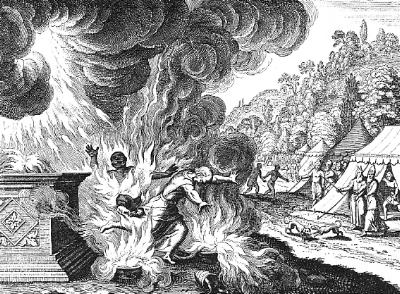
Aaron's sons Nadab and Abihu put coals of fire in their incense burners and sprinkled incense over them. In this way, they disobeyed the Lord by burning before him the wrong kind of fire, different than he commanded. So fire blazed forth from the Lord's presence and burned them up, and they died there before the Lord.
Ugh, once again we see that the Biblical God is a primitive, evil, control freak. Aaron stands there in stunned silence while Moses blathers on about God's holiness. Moses then tells Aaron and his remaining sons that if they mourn for the lost brothers, they will also die and God will strike at the whole community of Israel.

New Testament

More parables today. In most of the parables that involve farmers and seeds, it seems like we are supposed to take the farmer to be God/Jesus. Today we read a parable where such an interpretation is not obvious:
The Kingdom of God is like a farmer who scatters seed on the ground. Night and day, while he's asleep or awake, the seed sprouts and grows, but he does not understand how it happens. The earth produces crops on its own. First a leaf blade pushes through, then the heads of wheat are formed, and finally the grain ripens. As soon as the grain is ready, the farmer comes and harvests it with a sickle, for the harvest time has come.
This parable supports my standard interpretation in so far as it is the farmer who performs the harvest and plants the seed. However, the bits about the farmer not understanding how the seed grows into plants do not seem consistent with that interpretation. If the parable is supposed to be about spiritual growth and the farmer is supposed to be oneself, the bits about sleeping and lack of understanding make more sense, but the bits about planting and harvesting make less sense. Overall though, the second interpretation makes more sense.

Jesus demonstrates his power to calm storms and freaks out the disciples. I think it is kind of funny that the disciples accept healings as miraculous but acceptable, but affecting the weather leaves them "absolutely terrified". I would think after seeing the former, the later would be surprising but not that surprising.
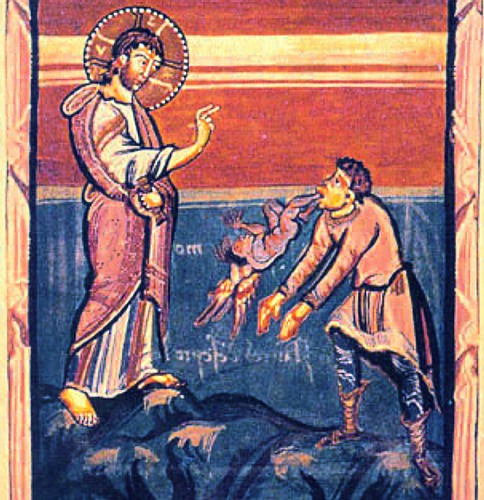
Jesus drives the demons into the pigs. In Matthew 8:28-34 Jesus drove demons out of two men. In Mark, there is only one man possessed by many demons. The interaction between the demon possessed man and Jesus is interesting enough that I want to quote it at length:
When Jesus was still some distance away, the man saw him, ran to meet him, and bowed low before him.With a shriek he screamed, "Why are you interfering with me, Jesus, Son of the Most High God? In the name of God, I beg you, don't torture me!" For Jesus had already said to the spirit, "Come out of the man, you evil spirit."

Then Jesus demanded, "What is your name?"

And he replied, "My name is Legion, because there are many of us inside this man." Then the evil spirits begged him again and again not to send them to some distant place.

There happened to be a large herd of pigs feeding on the hillside neraby. "Send us into those pigs," the spirits begged. "Let us enter them."

So Jesus gave them permission. The evil spirits came out of the man and entered the pigs, and the entire herd of about 2,000 pigs plunged down the steep hillside into the lake and drowned into the water.
The demons clearly seem to fear Jesus and his power. What is more interesting is that Jesus seems to be willing to listen to their pleas and send them into the pigs instead of sending them wherever he would have sent them otherwise. Also interesting, what happened to the demons after they drowned the pigs they were possessing? Did they just go on to possess someone/something else? Did Jesus even care? Based on this story, it seems to me that Jesus' main objection to demons is that they reveal that he is the son of God. He does not really care about preventing them from hurting people or causing damage.

Psalms and Proverbs

More of the same from both Psalms and Proverbs. Both can be summarized by two verses from today's reading from Psalms:
Look at those who are honest and good,
for a wonderful future awaits those who love peace.
But the rebellious will be destroyed;
they have not future.
All of this talk of wickedness leaves me confused though. Some parts of the Bible obviously condemn me as wicked. I do not believe in God, I commit blasphemy against the Holy Spirit whenever I feel like it, I have not made God's law my own, I do not put my hope in the Lord. According to many of the psalms and proverbs, I should, therefore, be doing a lot of things I do not do. I do not "wait in ambush for the godly, looking for an excuse to kill them." I do not have violent intentions. I do not think evil thoughts all the time. So, am I wicked or not? I am very confused.

19 February 2010

Feb 19

Reference links:

Old Testament

Today's reading informs us that a portion of each peace offering belongs to the priests. The phrasing of this rule supports the view that Leviticus was written long after the time of Moses (emphasis mine):
The special gifts presented to the Lord have been reserved for Aaron and his descendants from the time they were set apart to serve the Lord as priests. On the day they were anointed, the Lord commanded the Israelites to give these portions to the priests as their permanent share from generation to generation.
This passage occurs before the passage in Leviticus where Aaron and his sons are anointed (2 paragraphs before, in fact). The whole community assembled at the Tabernacle entrance for the anointing. Given the alleged adult male population of 600,000, this must have been an incredibly dull event for everyone but the few people who were close to the entrance.

Moses anoints Aaron and his sons. This is the same anointing that was described previously in Exodus 29.

New Testament

As the common source for Matthew and Luke, Mark contains many stories that are redundant with what we have already read. This can make it challenging to find something new to say.

Today we reread the story of how Jesus rejects his real mother and brothers in favor of those who do God's will. The author of Mark puts this story in a more interesting context. In yesterday's reading, we read,
When his family heard what was happening, they tried to take him away. "He’s out of his mind," they said.
Jesus was rejecting his family after they called him mad. Obviously, there were strains in the family relationships. This story also puts Mary in an interesting light. She is obviously much more conflicted about Jesus' claims to be the Messiah than popular portrayals of her indicate.

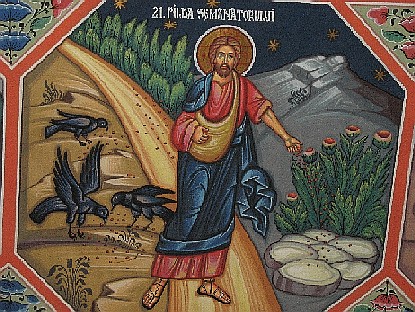
Another repeat is the parable of the farmer sowing seeds. Most of the seed does not yield fruit. It is eaten by crows or withers because of shallow roots, or choked by weeds. The disciples are confused by this parable and ask Jesus to explain it. The parable is supposedly confusing to fulfill a prophecy:
When they see what I do,
they will learn nothing.
When they hear what I say,
they will not understand.
Otherwise, they will turn to me
and be forgiven.
I already discussed how this is completely different than the original Hebrew. But Mark introduces some more interest. First, it differs from the fragment in Matthew. Second, it makes no sense! In particular, I cannot think of a reasonable way to interpret the phrase "Otherwise, they will" in the context of the rest of the passage.

I am amused by what Jesus says about the disciples' lack of understanding:
If you can't understand the meaning of this parable, how will you understand all the other parables.
I read that as, "Come on guys, this one is easy. If you cannot understand this one, there is no way you'll get the rest."

Psalms and Proverbs

Today's reading from Psalms continues the blame-the-victim theme from yesterday. This idea seems to run counter to the other Psalms where the psalmist complains about how the wicked prosper and the godly suffer.
Day by day the Lord takes care of the innocent,
and they will receive an inheritance that lasts forever.
They will not be disgraced in hard times;
even in famine they will have more than enough.

But the wicked will die.
The Lord's enemies are like flowers in a field --
they will disappear like smoke.

The wicked borrow and never repay, [no we don't!]
but the godly are generous givers.

...

Once I was young, and now I am old.
Yet I have never seen the godly abandoned
or their children begging for bread.
Only one verse from Proverbs today. I guess that is what they need to do to get it to span a year.

18 February 2010

Feb 18

Reference links:
Old Testament

More details about sacrifices: when to make them and how to make them properly. Sins that require a guilt offering include cheating in a deal, stealing, committing fraud, lying about lost property that was found, and lying while swearing to tell the truth. For all of these, the guilty party must return anything gained as a consequence of the crime plus an additional 20% and offer a guilt offering on the same day. Punishments are harsher for those who violate the purity laws of the community. Anyone who eats meat from a peace offering while they are ceremonially unclean or who eats blood ever will be cut off from the community.

This reading inspires interesting ideas about punishment in a nomadic tribe like that of the Israelites. Without permanent settlements, there seem to be two options for dealing with trouble makers: forgive them quickly or get rid of them completely. A group on the go would not find imprisonment practical.

New Testament

Crowds keep following Jesus because his fame has spread.
They came from all over Galilee, Judea, Jerusalem, Idumea, from east of the Jordan River, and even from as far north as Tyre and Sidon. The news about his miracles had spread far and wide, and vast numbers of people came to see him.
Jesus was a star. He kind of acted like one.
Jesus instructed his disciples to have a boat ready so the crowd would not crush him.
He and his disciples seem to show little concern for the members of the crowd who were probably crushing each other. As long as Jesus can get away in his boat, it is all okay.

Jesus chooses 12 of his disciples as apostles. These 12 would have the special privilege of accompanying him and he would give them the authority to cast out demons.  The teachers of the religious law accuse Jesus of working by Satan's power when he casts out demons. Jesus says this is silly because Satan would be fighting against himself if he allowed his power to be used to cast out demons.

However, if we believe the story about the pigs related in Matthew (and possibly again later?), then Jesus' casting out of demons may not actually be as unambiguously against Satan as today's text wants us to believe. In that story, Jesus casts the demons out of two men and sends them into a herd of pigs. The pigs go mad and plunge to their death (and, as far as we know, Jesus did not even apologize). This story makes it clear that casting out demons is not always the same thing as  working against Satan.

We also learn today that according to Jesus,
all sin and blasphemy can be forgiven, but anyone who blasphemes the Holy Spirit will never be forgiven. This is a sin with eternal consequences.
The phrasing here is odd. It says that "all sin and blasphemy can be forgiven" but those who blaspheme against the Holy Spirit "will never be forgiven". Is this implying that there are some sins that God/Jesus could choose to forgive (and, in the process save a person from eternal suffering and torture) but will not? Or am I putting too much emphasis on this translation's word choice?

Also, by these standards, I will never be forgiven. Ooops.

Psalms and Proverbs

Good advice from today's reading in Psalms (mixed into the standard fare of "God will punish the wicked and reward the good")
Stop being angry!
Turn from your rage!
Do not lose your temper --
it only leads to harm.
On the other hand, today's Proverbs reading encourages negative attitudes toward those who are suffering and needy:
The Lord will not let the godly go hungry,
but he refuses to satisfy the craving of the wicked.
Lazy people are soon poor;
hard workers get rich.
As organizations from all over the nation that fight poverty and hunger and homelessness know, the sources of poverty cannot be simplified down to someone being lazy. The sources of hunger cannot be simplified to someone being ungodly. Attitudes like those expressed in the above Proverbs only make it harder for those in difficult circumstances to find their way out of them again.

17 February 2010

Feb 17

The high priest will then take some of the bull's blood into the Tabernacle, dip his finger in the blood, and sprinkle it seven times before the Lord in front of the inner curtain. He will then put some of the blood on the horns of the altar for fragrant incense that stands in the Lord's presence inside the Tabernacle. -- Leviticus 4:16-18


Reference links:
Old Testament

Yesterday we learned about burnt offerings and peace offerings. Today we learn about sin offerings. If the high priest or the entire Israelite community sins, even without realizing it, a young bull without blemish must be offered. When other people sin they offer various goats. The interesting thing about sin offerings is that the one who sins must lay their hand on the sacrifice's head before the animal is killed. This, I suppose, represents a transference of the sin from the person to the animal. I wonder whether this was originally thought to symbolic or actual transfer of guilt.

A sin offering of a female sheep or goat are required for refusing to testify, touching something that is unclean, and making foolish vows. Two turtledoves or pigeons can be substituted by those who cannot afford a sheep or goat. If you cannot afford that, grain can be substituted. Before we saw that Mosaic law incorporated the idea of punishment being related to the damage caused rather than punishing based on intent. Today we see the idea of punishment being proportional to the means of the one being punished. This concept of punishment seems much more subtle than that held by modern mainstream America. Today's reading also emphasizes the point that punishment cannot be avoided just because the guilty one did not know they were committing a crime.

For defiling the Lord's sacred property the punishment is a ram with no defects and payment for the damaged property plus 20 percent. Once this payment has been made, the defiler is forgiven. Forgiveness is another concept we have lost track of in modern American ideas about punishment.

New Testament

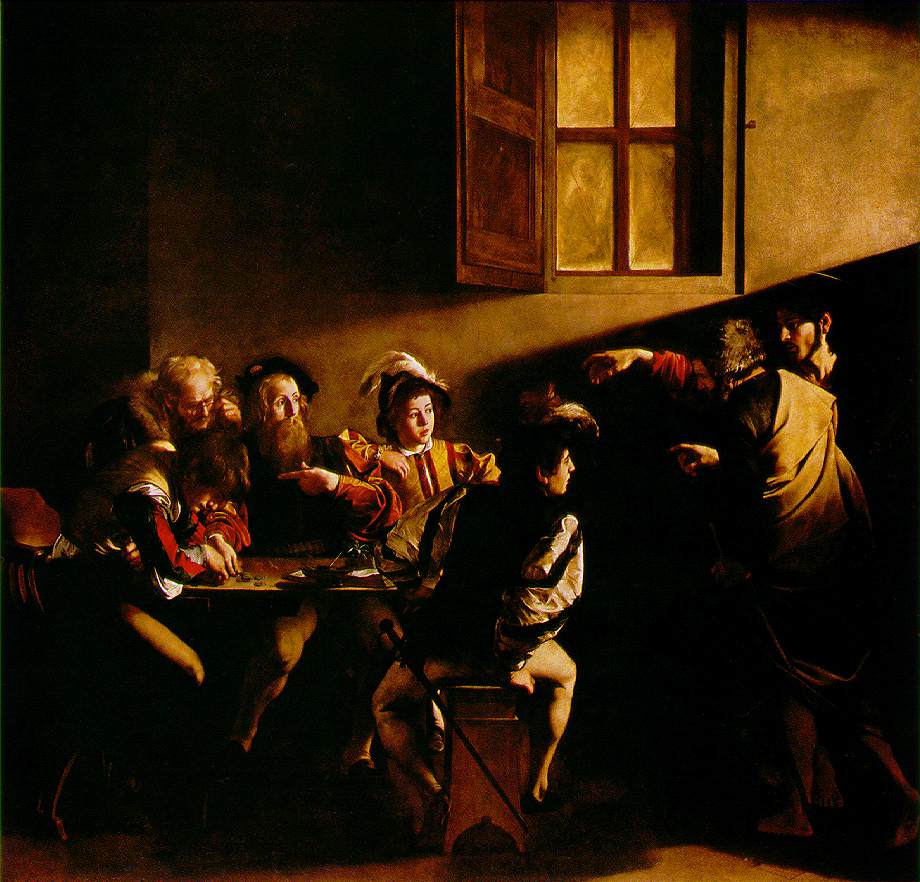
Jesus calls Levi (Matthew) to be one of his disciples.
Later, Levi invited Jesus and his disciples to his home as dinner guests, along with many tax collectors and other disreputable sinners. (There were many people of this kind among Jesus' followers.)
The Pharisees were baffled by this, but Jesus said,
Healthy people don't need a doctor - sick people do. I have come to call not those who think they are righteous, but those who know they are sinners.
This passage and other like it help illuminate an attitude I come across more often than I like. There are some Christians who give lip service to the idea that they are terrible sinners but show by their action and attitudes that they really believe they are better than everyone else. I have often wondered why they insist that they are sinners when they clearly do not believe it in their heart. Passages like this give a potential reason why: they think it brings them closer to Jesus. Ironically, this kind of public posturing really makes them more like the Pharisees than the sinners Jesus was dining with.

Today's reading repeats the story about Jesus and his disciples breaking off and eating grain in a field on the Sabbath. The Pharisees accuse Jesus of breaking the law and Jesus responds by relating a story about how David ate sacred loaves of bread once. What struck me about the story this time is that the Pharisees were there to see this. What were the Pharisees doing? Following Jesus around? Even in grain fields on the Sabbath? Seems rather silly.

Jesus does make an interesting statement as part of his response:
The Sabbath was made to meet the needs of people, and not people to meet the requirements of the Sabbath.
We really do all need a regular day of rest to separate ourselves from our daily concerns and focus on the big picture.

Psalms and Proverbs

Today's reading from the Psalms once again emphasize that everything the wicked do is evil and deceitful. They spend all of their times hatching evil plans. Once again, I am struct by the degree to which the Psalms draw caricatures of evil people. I believe few, if any, evil people have every been as constantly evil as the wicked are said to be the Psalms and yet these verses clearly impact how all atheists are perceived (since atheists are automatically assumed to be wicked, also, I believe, based on passages in Psalms and/or Proverbs).

Today's section of Proverbs starts the "Proverbs of Solomon" (who we will later learn was a wise king of Israel and son of King David and a wife he won by less than honorable means).

16 February 2010

Feb 16

How long, O Lord, will you look on and do nothing? Rescue me from their fierce attacks. Protect my life from these lions! Then I will thank you in front of the great assembly. I will praise you before all the people. -- Psalm 35:17-18
Reference links:
Old Testament

Here is what Wikipedia has to say about Leviticus:
Leviticus contains laws and priestly rituals, but in a wider sense is about the working out of God's covenant with Israel set out in Genesis and Exodus – what is seen in the Torah as the consequences of entering into a special relationship with God (specifically, Yahweh). These consequences are set out in terms of community relationships and behaviour.
It also notes that, like the other books of the Torah, tradition ascribes authorship to Moses but modern scholarship attributes the book to an unknown priest or priests. Overall, Leviticus defines what sets the Israelites apart as the people of God. This puts it in a peculiar relationship with Christian belief. Christians consider some of the laws in Leviticus to be explicitly cancelled by Jesus, some implicitly cancelled, and some to still be valid. Decisions about which laws belong in the second and third categories vary widely.  Oddly enough, in my observation, this variation seems to split along contentious contemporary issues.

The end of Exodus described the completion of the Tabernacle. The framing for Leviticus is that God continues to talk to Moses from the Tabernacle. He gives Moses more instructions about God's covenant with Israel.

Today's reading focuses on various types of offerings. Animals given for burnt offering must be males without defect and prepared properly. The smell of their burning pleases the Lord.

Birds presented as burnt offerings get the following treatment:
The priest will take the bird to the altar, wring off its head, and burn it on the altar. But first he must drain its blood against the side of the altar. The priest must also remove the crop and the feathers and throw them in the ashes on the east side of the altar. Then, grasping the bird by its wings, the priest will tear the bird open, but without tearing it apart.
Suppose you were to make a movie of a re-enactment of this scene. The priest, spattered with the blood of sacrificial animals, wrings the neck of a turtledove and tears it open, all with his bear hands. He then burns it, exclaiming upon how the scent is pleasing to his God. I wonder if most Christians would believe you if you told them this was part of their religious heritage.

God also accepts grain offerings. Whether raw, baked, or fried, God likes grain offerings to be presented with olive oil but no yeast or honey. The prohibition against yeast in offerings I can understand as hearkening back to the exodus from Egypt, but why no honey?

An animal sacrificed as a burnt offering has its whole body burned. An animal presented as a peace offering may be male or female, but still must have no defects. The priests only burn part of the animal on the altar. All animal sacrifices involve lots of spattering of blood on the altar. It was definitely not a sanitary affair.

Also, the Israelites are not allowed to eat any fat or blood. Is anyone reading knowledgeable enough about Jewish dietary law to provide more enlightenment about the prohibition against eating fat? Does it apply only to large, separable chunks of fat? Does it also apply to marbled fat?

New Testament

Jesus, James, and John visit the home of Simon (Peter) and his brother Andrew. While there, Jesus heals Simon's mother-in-law and many demon possessed people. Not surprisingly, since Mark is thought to be a source for Matthew, this is consistent with the story in Matthew. In fact, I have a feeling there is going to be a lot of redundancy as we go through the gospels.

It is interesting to compare stories across the gospels. In Matthew, the story of Jesus healing the leper was short (Matthew 8:1-4):
Large crowds followed Jesus as he came down the mountainside. Suddenly, a man with leprosy approached him and knelt before him. “Lord,” the man said, “if you are willing, you can heal me and make me clean.”
Jesus reached out and touched him. “I am willing,” he said. “Be healed!” And instantly the leprosy disappeared. Then Jesus said to him, “Don’t tell anyone about this. Instead, go to the priest and let him examine you. Take along the offering required in the law of Moses for those who have been healed of leprosy. This will be a public testimony that you have been cleansed.”
In Mark, we get all that, but additionally learn that Jesus sternly warned the man not to tell and that the man went and told people anyway. This caused people to follow Jesus all over,
and he couldn't publicly enter a town anywhere. He had to stay out in the secluded places, but people from everywhere kept coming to him. 
We also get more details about the paralyzed man Jesus healed in Matthew 9:2-8. Jesus was being mobbed by a crowd at a home he was visiting. Some clever folks wanted to get a paralyzed man to him, so they lowered the man on a mat through a hole in the ceiling. That makes for a much better story.

Psalms and Proverbs

Apparently, Folly is also a woman. A brash woman.