15 February 2010

Feb 15

Reference links:
Old Testament

We finish Exodus today! More repeats as we get another description of the priest's clothing: the ephod, chest piece, robes, and hat. After that Moses inspects everything and blesses it.

Now that all the pieces are complete Moses puts the Tabernacle together, and we get a repeat of where everything belongs. The text makes it sound like Moses put it all together alone. He probably did not (some of the pieces would have been impossible for one man to move alone), but the idea is still entertaining.
Moses erected the Tabernacle by setting down its bases, inserting the frames, attaching the crossbars, and setting up the posts. Then he spread the coverings over the Tabernacle framework and put on the protective layers, just as the Lord had commanded him. ... [more setup details] ... Then he hung the curtains forming the courtyard around the Tabernacle and the altar. And he set up the curtain at the entrance of the courtyard. So at last Moses finished the work.
Once everything is set up,
the cloud covered the Tabernacle, and the glory of the Lord filled the Tabernacle. Moses could no longer enter the Tabernacle because the cloud had settled down over it, and the glory of the Lord filled the Tabernacle. 
It is interesting that Moses could not enter the Tabernacle when the glory of God filled it. Earlier, in Exodus 33, we ready how God, in the form of a cloud, would hover at the entrance to the tent of meeting and talk with Moses. I guess Moses could interact with God's cloud, but not be immersed in it?

In any case, the cloud served as a signal to the Israelites which helped them determine when they could travel. They traveled, following the cloud, whenever it lifted from the Tabernacle. When it stayed settled on the Tabernacle, they would not travel.

And that's the end of Exodus.

New Testament

The book of Mark gets off to a quick start! But first, some background. According to Wikipedia:
The Gospel of Mark ... is the second of the four Canonical Gospels in the New Testament, but is believed by most contemporary scholars to be the first gospel written, on which the other two synoptic gospels, Matthew and Luke, were partially based.
This belief is based partially on the fact that Matthew and Luke agree with Mark on the details mentioned in Mark, but they disagree with each other on the details not mentioned in Mark. Having only started Mark and not yet got to Luke, I cannot assess that yet.


The Gospel of Mark was traditionally believed to not necessarily be strictly ordered, despite the narrative structure. Instead, an anonymous author traditionally identified as Mark, a cousin of Barnabas and/or a disciple of Peter, is said to have written the document to preserve the well known sayings and doings of Jesus.


Both the beginning and end of Mark are abrupt. The beginning starts with Jesus' baptism and ministry; it contains no nativity. What is traditionally believed to be the ending of Mark is now believed to be an addition by a later author. The original ending (Mark 16:8) is rather abrupt. Both at the beginning and the end, it is unknown whether this abruptness is intentional or the result of the original being lost.

We begin with a supposed fulfilled prophecy:
It began just as the prophet Isaiah had written:

"Look, I am sending my messenger ahead of you,
and he will prepare you way.
He is a voice shouting in the wilderness,
'Prepare the way for the Lord's coming!
Clear the road for him!'"
This prophecy is fairly reasonably in context, if only because the context is so vague it could refer to anything. The problem is that the context is not the context the author of Mark seems to think it is. According to the footnote, this is not even one quote. The first two lines are identified as being from Malachi 3:1. The last three are identified as being from Isiah 40:3! Once again, the Bible builds up the case for it not being the unerring word of God by showing failures of later books to correctly quote earlier books.

The text identifies John the Baptist as the messenger and Jesus as the one who would be coming. John baptizes Jesus. The Holy Spirit descends upon Jesus from the heavens, and a voice declares Jesus to be the voice's son (the voice, presumably, is God's).

John was arrested and Jesus started preaching in Galilee. He finds his first disciples, all fishermen (Simon, Andrew, James, John). He teaches in the synagogue in Capernaum and cast out an evil spirit. The audience thought this was awesome.

Psalms and Proverbs


Nothing of particular note in Psalms. Some nice lines from Proverbs.
If you become wise, you will be the one to benefit.
If you scorn wisdom, you will be the one to suffer.

14 February 2010

Feb 14

Reference links:
Old Testament

Today's reading is another recap episode. We get a detailed description of the building of the Ark of the Covenant, the table, the lamp stand, incense altar, washbasin, and courtyard curtains.

Useless but entertaining trivia: The Bible conveniently summarizes the materials used to craft all of this.
  • 2193 pounds of gold, donated by the people. At current prices of about 1000 per ounce, this is worth $35 million.
  • 7545 pounds of silver, received from the census tax. The census counted the population of Israel at 603,550 men over 20 (because those are the only people who count). At current prices of about $15 per ounce, this is worth $1.8 million.
  • 5310 pounds of bronze, at least some of which was from the bronze mirrors of the women. I couldn't find current prices, but the values I found mostly hovered around $1.50 per pound. At that rate, this is worth about $8000.

New Testament

We finally finish the Book of Matthew! Maybe in the next gospel we will get to see that overwhelmingly obvious love for all of us that is supposed to be scattered all over the Bible.

But before we get there, we have to finish today's reading. Mary Magdalene and the other Mary (wouldn't you hate to be "the other Mary"?) visit Jesus' tomb only to find an angel had rolled away the rock protecting the entrance and Jesus missing. The angel tells the women that Jesus had risen from the dead. They went to tell the disciples what had happened. On the way, they met Jesus and worshiped him.

Apologists hold up the empty tomb as clear proof that the resurrection really happened. They often overlook the obvious possibilities that the whole incident was fabricated or that the body was stolen. The author of Matthew shows slightly more awareness of the second possibility:
some of the guards went into the city and told the leading priests what had happened. A meeting with the elders was called, and they decided to give the soldiers a large bribe. They told the soldiers, "You must say, 'Jesus' disciples came during the night while we were sleeping, and they stole his body.' If the governor hears about it, we'll stand up for you so you won't get in trouble. So the guards accepted the bribe and said what they were told to say. Their story spread widely among the Jews, and they still tell it today.
Good attempt, but it fails to cast any real doubt on the suspicion that maybe Jesus' body was just stolen.

The Book of Matthew closes with Jesus meeting with the disciples and telling them,
Therefore, go and make disciples of all the nations, baptizing them in the name of the Father and the Son and the Holy Spirit. Teach these new disciples to obey all the commands I have given you. An be sure of this: I am with you always, even to the end of the age.
This is another one of those passages that was used to justify a lot of trouble historically. Although, for example, the mass murder of Native Americans in the US was really about territory and power, this type of religious rhetoric was certainly used as justification.

Psalms and Proverbs

Aw shucks, I guess I will never obtain wisdom.
Fear of the Lord is the foundation of wisdom.
Knowledge of the Holy One results in good judgment. 

13 February 2010

Feb 13


Reference links:
Old Testament

Nothing of interest today. Today's reading contains a detailed description of the building of the Tabernacle and describes how the people of Israel were so generous they donated more than enough supplies for everything. This pretty much repeats the earlier description of what the Tabernacle should be like.

New Testament

We finally get to the crucifixion, and I have nothing interesting to say about it. Plus, I am feeling snarky. Moral of the story: do not stay up late bowling with friends. =)

The Roman soldiers force some dude named Simon to carry Jesus' cross for awhile. This is surprising, because the standard story I hear is that Simon volunteered to carry Jesus' cross because he was faithful or something. Maybe we will read that version in one of the other gospels.

The people passing by mock Jesus as he is tortured to death (at least, I consider crucifixion a form of torture). Then Jesus dies.
At noon, darkness fell across the whole land until three o'clock. At about three o'clock, Jesus called out with a loud void, "Eli, Eli, lema sabachthani?"which means "My God, my God, why have you abandoned me?"
If Jesus is wholly one with God in some supposedly intentionally confusing trinity, what does it mean when Jesus asks why God has abandoned him?

Jesus' death causes quite a commotion.
Then Jesus shouted out again, and he released his spirit. At that moment the curtain in the sanctuary of the Temple was torn in two, from top to bottom. The earth shook, rocks split apart, and tombs opened. The bodies of many godly men and women who had died were raised from the dead. They left the cemetery after Jesus' resurrection, went into the holy city of Jerusalem, and appeared to many people.
It seems odd that no surviving records outside the Bible corroborate this claim. If I were like those people who say evolution could not have happened because we have not found all transitional forms, then I would be forced to conclude that these things probably did not happen at Jesus' death because there is not 100% certain evidence for them. Oh wait! No I wouldn't, because then I would assume the Bible is special.

Jesus gets buried by Joseph of Arimathea, and the priests decide to put a guard at the tomb to make sure Jesus' body is not stolen by his followers.

Psalms and Proverbs

Finally, we get to some wisdom in Proverbs, and it is actually pretty good.
Anyone who rebukes a mocker will get an insult in return.
Anyone who corrects the wicked will get hurt.
So don't bother correcting mockers;
they will only hate you.
But correct the wise,
and they will love you.

12 February 2010

Feb 12

Reference links:
Old Testament

It seems the point of Moses getting upset and smashing God's tablets was to give the Biblical author a chance to repeat himself (although Moses has to chisel it out this time instead of God just writing it out for him; no wonder it took forty days). Selective repetition emphasizes certain points, so let's see what points God/the Biblical author thought were worth emphasizing.

God describes himself. Remember, this is the God who would have killed all of Israel for worshiping the golden calf if Moses had not reminded him of his promises to the patriarchs. This is the God who murdered and tortured Egyptians just to show his own power. Here is how he describes himself:
Yahweh! The Lord!
The God of compassion and mercy!
I am slow to anger
and filled with unfailing love and faithfullness.
I lavish unfailing love to a thousand generations.
I forgive iniquity, rebellion, and sin.
But I do not excuse the guilty.
I lay the sins of the parents upon their children and grandchildren;
the entire family is affected --
even children in the third and fourth generations.
The last four lines are consistent with the God we have seen so far. The rest does not seem as fitting. Also, if God lavishes love for a thousand generations and lays sin upon children for three or four, are the children of a sinner who is the grandchild of a faithful follower loved or punished?

God also considers it worthwhile to repeat that the Israelites should under no conditions make treaties with the people who live in the land they will soon be conquering. Instead, they are supposed to destroy all marks of the foreign religions. I am not sure the God of the Bible would be happy with the people who allow other faiths to have buildings of worship in their communities.

As for the rest: Celebrate some festivals; give God the firstborn animals and children; keep the sabbath; do not combine blood and yeast in offerings; do not cook young goats in the milk of their mothers. Not quite as interesting as the first couple repetitions.

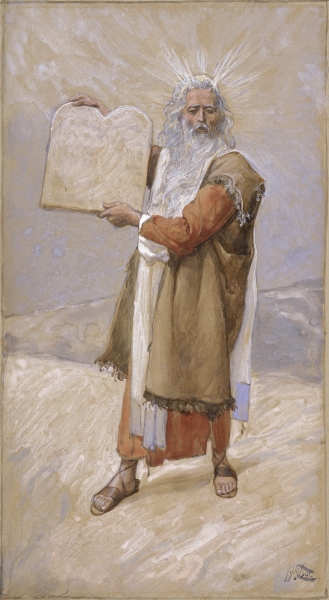
After this Moses goes back down to the people. He glows brightly with the glory of God and covers his face. Shiny!

New Testament

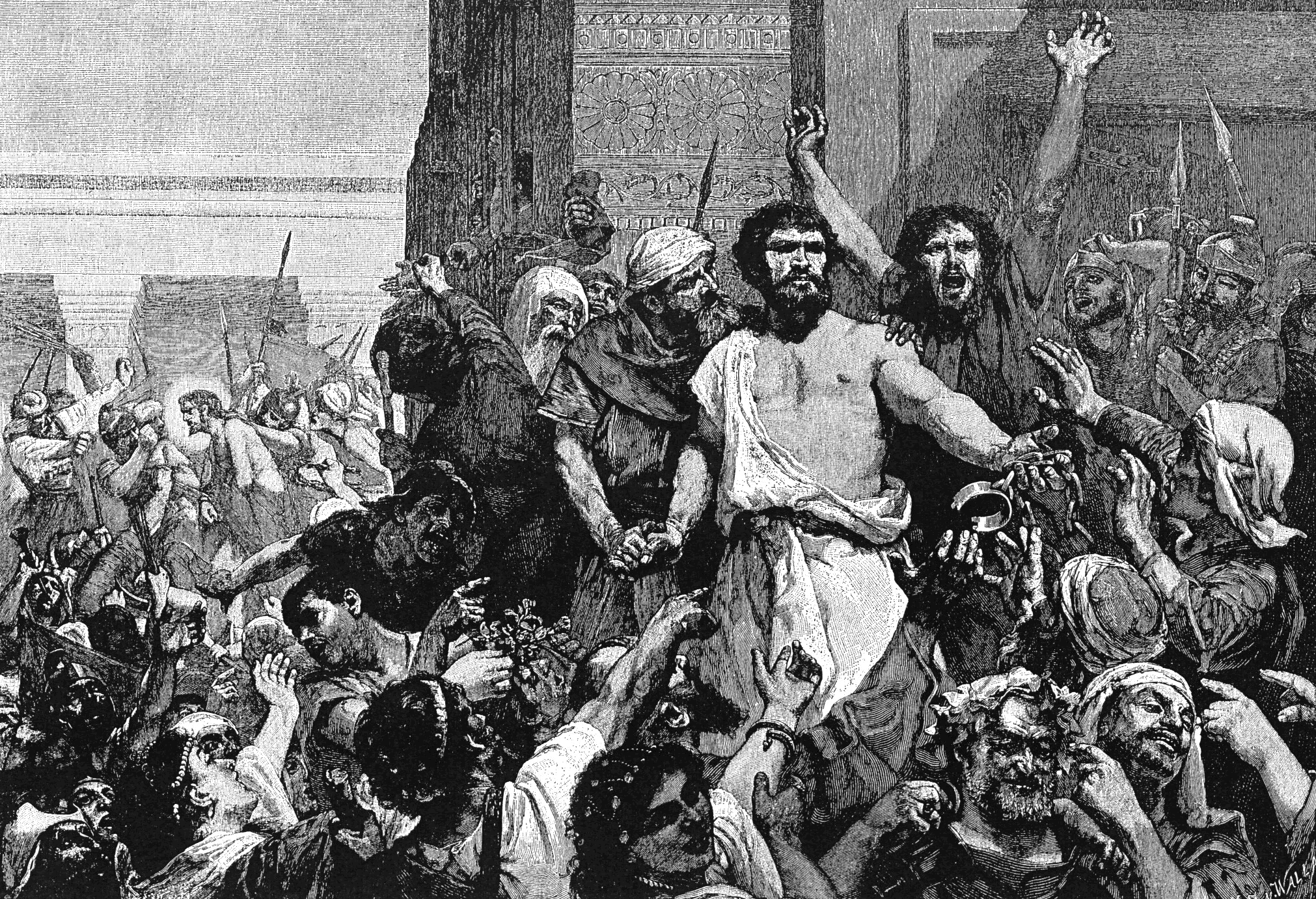
Pilate gave the Jews a chance to release one prisoner, as was traditional. Prompted by the priests who had had Jesus arrested, the crowds chose a notorious prisoner, Barabbas. So the people who the priests feared would rise up in rebellion if they acted against Jesus earlier were able to persuade the people to act against him so quickly?

Yesterday, the Israelites were portrayed as extremely changeable; they went from worshiping God to worshiping a golden calf just because the calf was there. Today, we see that the crowds that are equally changeable. I would say that the crowds are swayed with unrealistic ease, but then I remember what crowds are like today and think maybe the people in the time of Moses and in the time of Jesus were no more or less changeable than the people now.

Pilate's wife tries to persuade him to release Jesus because she dreamed that he was innocent (what would people say if the spouses of modern politicians tried to use their dreams to influence public policy?). Pilate tries to get the crowd to release Jesus, but the crowd says to crucify him and agrees to take responsibility for his death. I am not good with history, but I believe that this is one of those passages that has been wrongly used to justify antisemitism in the past. Even if this story were true and if the people could take on responsibility for Jesus death by declaring it, one could hardly say a crowd that had gathered one day in Jerusalem had the power to bind all of the Jewish people.

And then some Roman soldiers make fun of Jesus. It makes me glad we live in a society where such behavior is considered unacceptable (unless you're a guard watching suspected terrorists wait, I do not talk about current events on this blog).

Psalms and Proverbs

Psalms continues with the theme that God watches over those who are faithful to him. For two of the lines in today's reading, I will give a half point to those who believe that everyone will be saved:
He made their hearts,
so he understands everything they do.
The verse does not explicitly support the universal salvation viewpoint, but it could be used to supplement such an argument.

Proverbs contains more prelude to discussing wisdom. Believers in pseudoscience should take this verse to heart:
Leave your simple ways behind, and begin to live;
learn to use good judgment.

11 February 2010

Feb 11

Reference links:
Old Testament

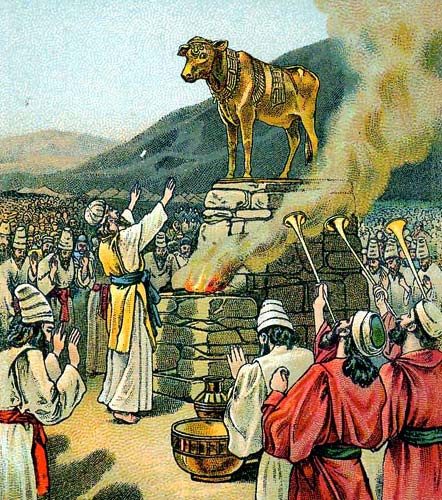
Today's we come to the story of the golden calf.

The people get bored waiting for Moses and ask Aaron for an idol. Aaron says "sure", takes all their gold, melts it, and makes a calf. The people see the calf and say that it is the God that brought them out of Israel.

God notices the idol worship and sends Moses down to stop it, but not until after he threatens to kill them all. Moses dissuades God by appealing to his ego,
"O Lord! " he said. "Why are you so angry with your own people whom you brought from the land of Egypt with such great power and such a strong hand? Why let the Egyptians say, 'Their God rescued them with the evil intention of slaughtering them in the mountains and wiping them from the face of the earth'? Turn away from your fierce anger. Change your mind about this terrible disaster you have threatened against your people! Remember your servants Abraham, Isaac, and Jacob. You bound yourself with an oath to them, saying, 'I will make your descendants as numerous as the start of heaven. And I will give them all of this land that I have promised to your descendants, and they will possess it forever."

So the Lord changed his mind about the terrible disaster he had threatened to bring on his people.
Moses tells the people of God's anger. Aaron makes up some weak excuse about how he threw the gold into the fire, a calf just popped out. God and Moses decide that the situation calls for mass murder. Moses gathered all those who considered themselves on the side of God and
told them, "This is what the Lord, the God of Israel, says: Each of you, take your swords and go back and forth from one end of the camp to the other. Kill everyone - even your brothers, friends, and neighbors." The Levites obeyed Moses' command, and about 3,000 people died that day.
Brutal, primitive, morally reprehensible.

Here is my guess as to the real story. Aaron took advantage of an absence of Moses to make a grab for power. Moses returned and a power struggle ensued. As part of this power struggle, Moses murdered some people. This scared enough to convince them to follow Moses. The people are portrayed as weak willed and stupid to make Aaron look sinful and strengthen Moses' claim to be God's chosen leader.

After the murders, God sends a plague on the Israelites just to make sure they are good and punished. Lovely.

New Testament

When we last saw Jesus, the Jewish religious teachers were trying him for blasphemy. Today, Peter denies three times that he is Jesus' follower, just as Jesus predicted he would. Jesus gets taken to the Roman governor, Pilate, so that he can be put to death. Judas feels guilty about causing Jesus' death and hangs himself after giving the money back to the priests.

The bit about Judas supposedly fulfills another prophecy.
This fulfilled the prophecy of Jeremiah that says,

"They took the thirty pieces of silver --
the price at which he was valued by the people of Israel,
and purchased the potter's field,
as the Lord directed."
The footnote cites two locations: Zechariah 11:12-13 and Jeremiah 32:6-9. Here is the passage from Zechariah:
I told them, "If you think it best, give me my pay; but if not, keep it." So they paid me thirty pieces of silver.

And the LORD said to me, "Throw it to the potter"-the handsome price at which they priced me! So I took the thirty pieces of silver and threw them into the house of the LORD to the potter.
Zechariah seems to be speaking symbolically and/or prophetically here, so he could be speaking of Judas. However, the passage does not mention a field at all, just a potter. Furthermore, the text cited Jeremiah, not Zechariah. Let's see what the relevant passage in Jeremiah says.
Jeremiah said, "The word of the LORD came to me: Hanamel son of Shallum your uncle is going to come to you and say, 'Buy my field at Anathoth, because as nearest relative it is your right and duty to buy it.'

"Then, just as the LORD had said, my cousin Hanamel came to me in the courtyard of the guard and said, 'Buy my field at Anathoth in the territory of Benjamin. Since it is your right to redeem it and possess it, buy it for yourself.'

"I knew that this was the word of the LORD; so I bought the field at Anathoth from my cousin Hanamel and weighed out for him seventeen shekels of silver.
This passage is completely different! There is no feasible way it can be interpreted to be talking about the same thing as the first passage. Furthermore, it bears even less resemblance to the so called prophecy. It seems like the author of Matthew just got a bit confused and conflated two different passages. Oops.

Another prophecy fail. Maybe the worst one yet.

Psalms and Proverbs

Today's reading from the Psalms presents an interesting juxtaposition to the reading from Exodus.
But the Lord's plans stand firm forever;
his intentions can never be shaken.
Really? Tell that to Moses, who persuaded God not to kill the people of Israel. The reading form Exodus specifically says, "So the Lord changed his mind".

Today marks the fifth day of Wisdom going on about how great she is without actually conveying any wisdom. Better than droning on about immoral women, I suppose.