10 February 2010

Feb 10

Reference links:
Old Testament

Sneak preview! Later in the Bible, God will get super angry at David for taking a census. God does not explain why he is angry. Today's reading gives a possible reason. God tells Moses,
Whenever you take a census of the people of Israel, each man who is counted must pay a ransom for himself to the Lord. Then no plague will strike the people as you count them. Each person who is counted must give a small piece of silver as a sacred offering to the Lord.
So maybe God's anger at David was because David failed to have the people ransom themselves with silver.

God gives details for making a wash basin, anointing oil, and incense. He then tells Moses that the people should keep the Sabbath holy and gives him a couple stone tablets with the terms of the covenant written by the finger of God.

New Testament

Plot summary: Judas betrays Jesus with a kiss. Armed men arrest Jesus. One of Jesus' followers moves to defend Jesus, but Jesus tells him to stop, but not until an enemy ear has been detached from its owner. The disciples flee. The high priests and teacher of religious law try to trap Jesus with false witnesses. Jesus is finally convicted when he does not deny being the Messiah or the Son of God and says that he will someday sit at the right hand of God.

Now, I do not believe in killing people for blasphemy, but I think I have to agree with the religious teachers that this is something they could legitimately consider blasphemy. So everyone deserves some blame here. On the one hand, the religious teachers plotted Jesus' death because they saw him as a threat. On the other hand, it would be difficult to say that he was convicted of blasphemy unjustly.

On thing is clear, however. the subsequent beating of and spitting upon of Jesus by the gathered crowds is not how civilized legal proceedings should conclude.

Psalms and Proverbs

Today's reading from the Psalms has more good sense once you ignore the bit about God and the Christian conception of sin and replace them with more humanistic notions.
When I refused to confess my sin,
my body wasted away,
and I groaned all day long.
When you do something wrong, and you know it, and you cannot get rid of the guilt, it does eat at you. Your emotional state effects your physical well being and your ability to live your life properly. It has nothing to do with God's discipline, but the effect is certainly real.

Proverbs continues to personify wisdom. Almost to the point where, if these passages were to be taken literally, Wisdom could be considered the Goddess consort of God the creator.
I was the architect at his side.
I was his constant delight,
rejoicing always in his presence.
And how happy I was with the world he created;
how I rejoiced with the human family!

09 February 2010

Feb 9

Reference links:
Old Testament

Today we learn how Aaron and his sons must be consecrated before they can serve the Lord. It seems odd that Aaron and his sons become the line of priests. Why not Moses and his sons? Was it because the priests had to be good public speakers, and that was Aaron's role? Was it because Moses had not circumcised one of his son's properly?

Priests are consecrated by the sacrifice of a bull and two rams. These animals must be without defect; God is picky about that. The blood of these sacrifices gets smeared on the altar and on the priests. For example, the second ram undergoes the following process:
slaughter it, and apply some of its blood to the right earlobes of Aaron and his sons. Also put it on the thumbs of their right hands and the big toes of their right feet. Splatter the rest of the blood against all sides of the altar. Then take some of the blood from the altar and some of the anointing oil, and sprinkle it on Aaron and his sons and on their garments. In this way, they and their garments will be set apart and holy.
Such rituals show that the God of the Old Testament is a primitive God, very similar to other primitive Gods. God wants bloody sacrifices and enjoys the smell of burning meat. Once again, I am surprised that people expect that reading the Bible would make any non-believer think more highly of the Christian God. There are moments of inspiration (we get one later today even), but they are far outweighed by these moments.

New Testament

Plot advancement! The disciple Judas Iscariot agrees to betray Jesus to the priests for 30 pieces of silver. The reasons behind Judas' betrayal are glossed over. Why would he betray Jesus? The standard explanation is that he was an evil person, but I feel like the story must be more complicated than that. (Unless, as is not unlikely, the betrayal story is complete fiction; then Judas is just a plot device.) The story has not paid much attention to Judas, so we cannot glean much information about his personality. However, we have seen a lot about Jesus' personality, and what we have seen indicates that he can be harsh, impatient, and moody. Perhaps Judas had come to the conclusion that Jesus really was a dangerous lunatic and was not so much betraying Jesus as turning him in.

After Judas agrees to betray Jesus, the disciples gather for the Passover supper. Jesus reveals that one of them betray him, and they all wonder (or pretend to wonder, in Judas' case) the identity of the betrayer. When Judas asks Jesus if he is the betrayer, Jesus more or less indicates that that is the case.

During the meal, Jesus blesses some bread, saying
Take this and eat it, for this is my body.
He then blesses a cup of wine saying,
Each of you drink from it, for this is my blood, which confirms the covenant between God and his people. It is poured out as a sacrifice to forgive the sins of many.
As discussed above, the idea of a God who needs bloody sacrifices to give forgiveness comes off as primitive (and, to be honest, kind of disgusting). Also, I know different denominations disagree as to whether the bread and wine were symbolically or actually Jesus' body and blood. In my opinion, if the transformation was not symbolic, it is icky.

After supper, Jesus prays,
My Father! If it is possible, let this cup of suffering be taken from me. Yet I want your will to be done, not mine.
And prays again,
My Father! If this cup cannot be taken away unless I drink it, your will be done.
And prays a third time, saying the same things. For the first time in the Book of Matthew, Jesus appears less than confident and self-assured. He seems afraid and humble. I actually feel sympathy for him.

Psalms and Proverbs

The Psalms often mention God's earthly protection for those who prove faithful to him. Yet reality shows that the faithful receive no more protection from hardship than the rest of us. It seems like modern Christianity, realizing this, has revised this protection to be spiritual and eternal, not material and finite. However, this flies in the face of the protection described here.

Today's Proverbs reading continues to present the nature of wisdom. Forget for a moment the hypocrisy of those Christians who claim to have wisdom while disdaining two vital tools of wisdom, critical thinking and the scientific method. If you can move beyond that, the text presents some enjoyable sentiments.
Common sense and success belong to me [wisdom].
Insight and strength are mine.
Because of me, kings reign,
and rulers make just decrees.
Rulers lead with my help,
and nobles make righteous judgments.

I love all who love me.
Those who search will surely find me.
I have riches and honor,
as well as enduring wealth and justice.
My gifts are better than gold, even the purest gold,
my wages better than sterling silver!

...

The Lord formed me from the beginning,
before he created anything else.
The last two quoted lines give one of those rare glimpses of a deity that seems worthy of this wonderful universe we live in.

08 February 2010

Feb 8

Reference links:
Old Testament

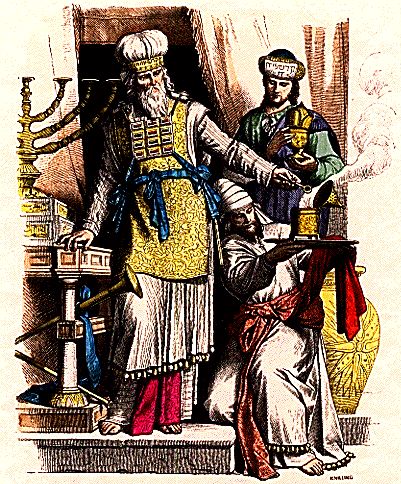
Today is all about fashion. This year's line focuses on fashion for priests. On his shoulders, the priest will wear the ephod. With two engraved onyx stones set in a lovely gold filigree, the fashionable priest will be sure to remember the people of Israel when he goes before the Lord.

Hanging from the ephod we have the chest piece, a jewel lover's dream. 12 stones, one for each tribe, adorn this lovely linen pouch. The pouch is embroidered in gold, blue, purple, and scarlet. Attach it to the ephod with two cords of pure gold thread and you have a stunning accessory! But function accompanies beauty in this piece. The chest piece pouch is the perfect size for your favorite divination tools, the Urim and Thummim.

With such opulent accessories you need an equally elaborate garment. God has commissioned a robe made from a single piece of blue cloth (the only way to assure a perfect match with traditional dying techniques). God, ever practical, had Moses reinforce the collar so it will not tear. The hem of the robe should be lined with alternating bells and pomegranates. A risky choice, but one that God can pull off, if anyone can.

This outfit demands a hat. God is trying to go for a street vibe here by using some visible branding. Usually a no-no in high fashion. We'll see how the critics respond to a medallion engraved with "Holy to the Lord".

God knows that a well dressed priest wears quality inside and out. That is why he insists all his priests wear fine linen undergarments, reaching from their waists to their thighs. With undergarments like these, the priests can avoid dieing of the guilt that comes from wearing low quality underwear. Good call God.

New Testament

Today is one point up for those who believe the apologetic put forth by C.S. Lewis in The Last Battle: it is possible to worship the one true God by another name. Jesus says that those who inherit the Kingdom of Heaven do so because they took care of the unfortunate and, in doing so, took care of Jesus, while those who spurned the unfortunate were spurning Jesus.

It's one point down for those who think that everyone will be saved eventually. Those who spurned Jesus through their treatment of the unfortunate
will go away into eternal punishment
Also, poor goats. Is it really fair to make a symbol for the people who are going to hell?

Today's reading has a good lesson. The time nears when Jesus will be crucified. A woman pours a jug of expensive perfume over his head. The disciples scold her because the perfume could have been sold and the profits used for the benefit of the poor. Jesus stops them. He appreciates this bit of anointing before his death. Even if you ignore the symbolism of the anointing of Christ before his death, this reading still provides a great lesson in living in the moment. We should not always focus on the future. Sometimes we should just appreciate what we have.

Psalms and Proverbs

Today's reading from the Psalms is standard fodder, but a couple lines inspire me.
Sin has drained my strength;
I am wasting away from within.
I do not buy into the Christian narrative of humans being inherently sinful. Humans are human, and that involves both good and bad. But we can take a secular view of sin. If you look at it as a certain loss of balance in the harmony within your self and the harmony between you and the world around you, then this sin does drain your strength. Perhaps part of the appeal of religion is that it is an easy way to get rid of this tension without having to do the hard work of discovery on your own.

07 February 2010

Feb 7

Reference links:
Old Testament

Today's Old Testament reading continues God's painstakingly detailed description of the Ark of the Covenant and its housing. I have included a schematic diagram. The walls are all made of blue, purple, and scarlet embroidered curtains. The pieces all made of silver, gold, or bronze. When wood is used, it is acacia wood. Unless you want to build one yourself, you probably do not need to bother with today's reading.


New Testament

Hurrah! Jesus finishes talking about the end of the world directly and goes back to talking about it in parables. We get two today.

  • Ten virgins go to meet the bridegroom. Five of them bring enough oil, five do not. The ones who do not go and buy some more. The bridegroom arrives before they return, and he locks them out of the marriage feast. Lesson learned: Jesus is not going to forgive those who do not follow him when the end times come. Point against the belief that everyone will be saved eventually.
  • The other parable involves three servants. Jesus gives them 5, 2, and 1 bags of gold respectively. The one who gets 5 invests it and earns 5 more. The one with 2 invests it and gets 2 more. The one who gets one fears his master and buries the money. When the master returns, he praises the first two servants and scorns the third one. Lesson: "To those who use well what they are given, even more will be given, and they will have an abundance. but from those who do nothing, even what little they have will be taken away." One wonders what the master would have done to a servant who had used what they were given badly (i.e., lost money).
The combined lesson of these parables, in my opinion, is that it is not enough to claim to be a follower of Christ. You have to act on your belief and use your gifts in service to Jesus. If you do not, it does not matter how much you want it or how sincere you are, Christ will not let you into heaven.

Of course, that would be a lot more reasonable if the truth of Christianity were actually as obvious as Jesus claims.


Psalms and Proverbs

Nothing of particular note except that we may be moving beyond immoral women in Proverbs. We cannot be sure though, because today's reading is another prelude that can be summarized as "Wisdom is great. Get some!"

06 February 2010

Feb 6

I will send terror ahead of you and create panic among all the people whose lands you invade. I will make all your enemies turn and run. I will send terror ahead of you to drive out the Hivites, Canaanites, and Hittites. -- Exodus 23:27-28


Reference links:

Old Testament

In today's reading, God tells Moses that he will send an angel to protect the Israelites as they take over the land God promises to them. God promises to oppose all who would thwart the Israelites as long as they obey all his commands.
For my angel will go before you and bring you into the land of the Amorites, Hittites, Perizzites, Canaanites, Hivites, and Jebusites, so you may live there. And I will destroy them completely.
God promises to commit genocide. Lovely. The Israelites agree to this covenant (to seal it, Moses sprinkles blood on them).

Moses, Aaron, Nadab, Abihu, and seventy elders of Israel climb Mount Sinai and see the God of Israel. God likes to stand around on surfaces that look like "brilliant blue lapis lazuli, as clear as the sky itself". Good taste! Lapis lazuli is a favorite of mine.

Throughout the rest of today's reading, God gives Moses detailed instructions on the design of the Ark of the Covenant, a table, and a lampstand. God likes gold.

New Testament

Jesus continues to drone on about the end of the world. We also read Jesus' claim,
I tell you the truth, this generation will not pass from the scene until all these things take place. Heaven and earth will disappear, but my words will never disappear.
The footnote says that generation may be translated as "age" or "nation". However, if generation was the most likely translation then Jesus was wrong, or he was using "generation" in a very non-standard way.

Psalms and Proverbs

According to today's reading from Psalms, God's
anger lasts only a moment,
but his favor lasts a lifetime!
But remember, this is only if you are not the Amalekites. God hates them forever.

Today's reading from Proverbs sounds like it might be an epilogue to the teachings about avoiding immoral women. I sure hope so.