02 February 2010

Feb 2

Reference links:

Old Testament

In summary: the Israelites wander through the desert and whine. First, they wander for three days without finding water. They finally find water, but the water tastes bitter. Fortunately, Moses consults God, and God gives Moses a stick to throw in the water that removes the bitterness.


At this place, Marah, God tells the Hebrews
If you will listen carefully to the voice of the Lord your God and do what is right in his sight, obeying his commands and keeping all his decrees, then I will not make you suffer any of the diseases I sent on the Egyptians; for I am the Lord who heals you.
I wonder if this refers to the diseases that were part of the plagues. That would be odd, because none of them other than boils and the deaths could really be described as diseases on people. It could, instead, refer to the diseases the Egyptians came down with generally. Either way, it is kind of an odd interlude.

Next the people go on to Elim,
where they found twelve springs and seventy palm trees.
Remember, when they left Egypt there were 600,000 men plus women and children. Likely over a million people. Each spring had to support 83,000 people. That seems like a lot.

The Israelites complain about not having good food (selectively remembering the meaty stews in Egypt and forgetting the slavery), so God gives them quails and manna from heaven. Manna tasted like honey and looked like flaky frost on the ground. It melts in the sun. Aaron saved some and eventually placed it in the Ark of the Covenant. In this passage, God teaches the Israelites to do no work on the sabbath. Not all the Israelites listened; they tried to gather manna that day. This frustrated God.
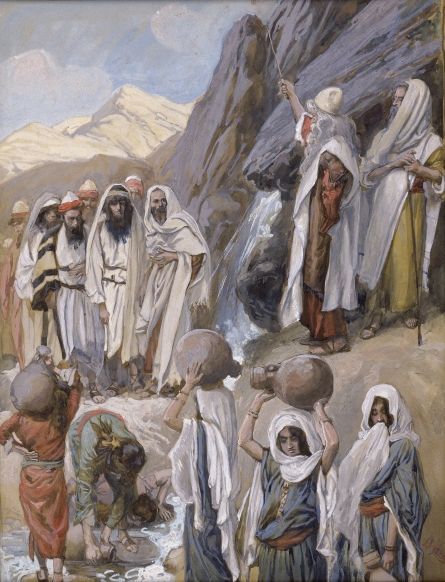
After that, the camp moved on to Rephidim.
but there was no water there for the people to drink. So once more the people complained against Moses. "Give us water to drink!" they demanded.

"Quite!" Moses replied. "Why are you complaining against me? And why are you testing the Lord?"
Yup, Moses is that much of a jerk. Here we have a group of over a million people. They have no water. They are marching through the desert. They complain about the lack of water and ask Moses for some. Moses, who has demonstrated his ability to perform miracles time and again. And because they ask for wanter Moses accuses them of testing the Lord. What does he want them to do? Die of thirst? Yes, the Israelites had a serious case of selective memory with respect to life in Egypt, but it sounds like life under Moses was no picnic either.

In any case, once the people get to the point where they are ready to stone Moses, he asks God for help, and God tells him to smack a rock. Water come out of the rock. Hurrah!

New Testament
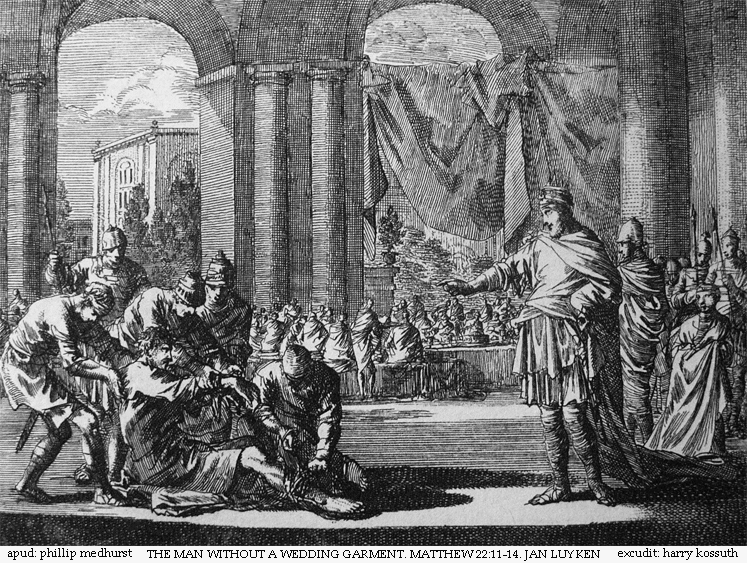
Jesus tells another parable about how the Jews totally are not going to get the rewards God originally intended for them unless they follow Jesus. A king prepares a wedding feast for his son. None of the guests come, so he invites random people. One of the random guests shows up in everyday clothing and the king has him bound and thrown out. Jesus is harsh toward those who do not follow him.

Jesus escapes a trap set by the Pharisees. They ask him about paying taxes. He sees their trap and says that since the coin shows Caesar's face, it is acceptable to give it to him. The Sadducees tried to confound Jesus by asking him about resurrection. They asked about a woman who had been married to each of seven brothers (serially, kind of like Tamar and Judah's sons). The Sadducees asked whose wife she would be in heaven. Jesus replied that people would not be married in heaven. Good to know!

Psalms and Proverbs

Today's psalm has some nice imagery.
At his santuary I will offer sacrifices with shouts of joy,
singing and praising the Lord with music. 
What a great way to praise something! Shouts of joy, singing and music! What fun!

Proverbs tells us to obey our parents. In particular, listening to our parents will keep us away from immoral women. I think the proverbs have something of an obsession with immoral women.

01 February 2010

Feb 1

Reference links:

Old Testament

God detours the people of Israel to the Red Sea. He has been leading them with a pillar of cloud in the day and a pillar of fire in the night.  The Israelites are on their way with the Egyptian treasure. Now that things are going well, God makes trouble again. He says,
Order the Israelites to turn back and camp by Pi-hahiroth between Migdol and the sea. Camp there along the share, across from Baal-aephon. Then Pharaoh will think, "The Israelites are confused. They are trapped in the wilderness!" And once again I will harden Pharaoh's heart, and he will chase after you. I have planned this in order to display my glory through Pharaoh and his whole army. After this, the Egyptians will know that I am the Lord.
Pharaoh and his army pursue the Israelites, but, once again, the blame actually belongs to God. When Pharaoh's army approaches the camp of the Hebrews, Moses parts Red Sea.
the Lord opened up a path through the water with a strong east wind. The wind blew all that night, turning the seabed into dry land. So the people of Israel walked through the middle of the sea on dry ground, with walls of water on each side!
I like the juxtaposition of a naturalistic explanation (God created the path with a strong east wind) with the miraculous (the walls of water on either side).

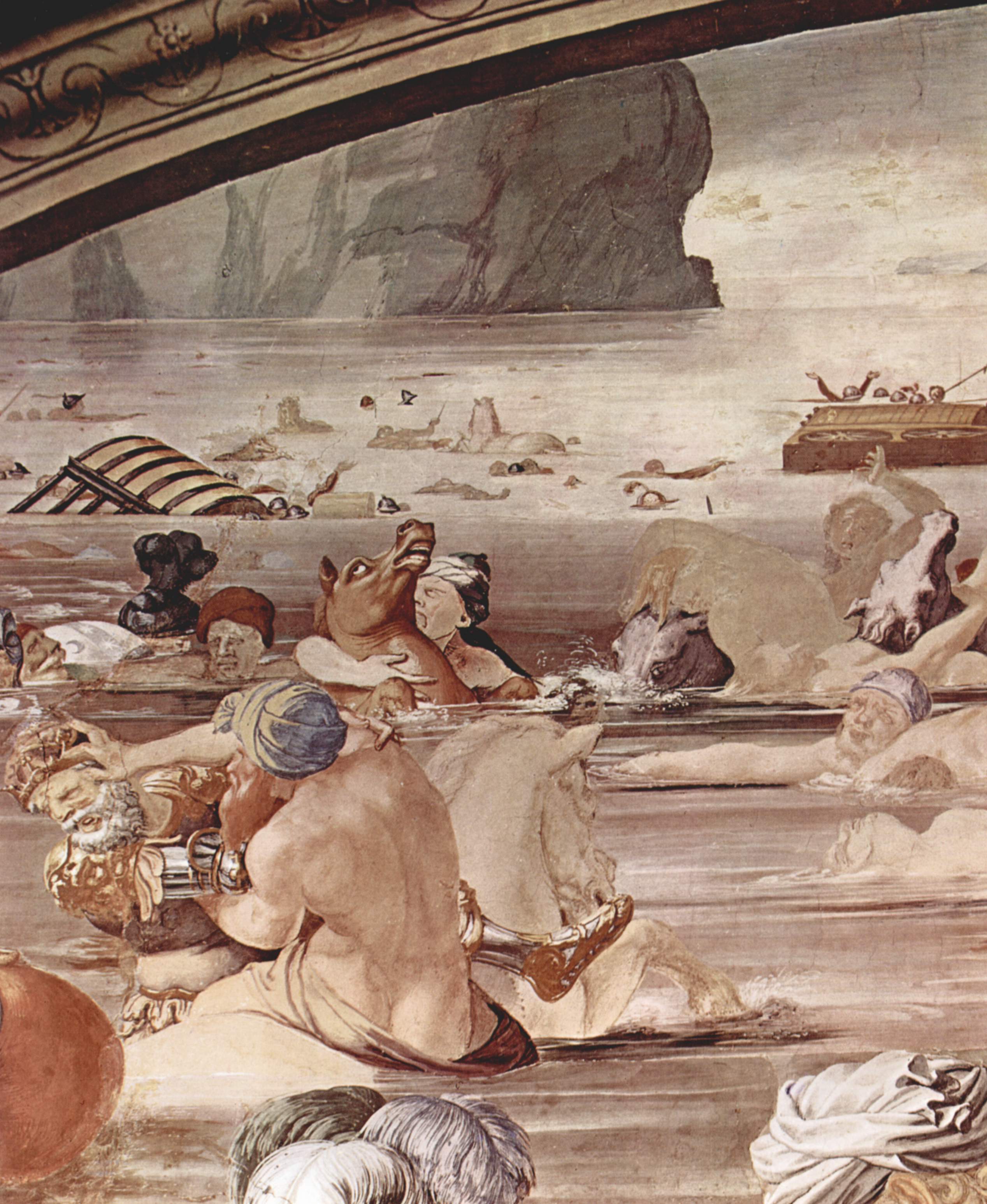
Of course, Pharaoh and his men ride into the sea, Moses raised his hand, and the waters rushed back into place. God killed more people just so that he could show his power.

The rest of today's reading consists of a song of deliverance that includes the line
Who is like you among the gods, O Lord
On the one hand, this line comes from poetry and so should not necessarily be taken literally. On the other hand, it implies that God was seen by the Hebrews as the greatest God among many.

New Testament

Today's reading focuses on the strained relationship between Jesus and the Jewish priests and elders. First, the priests and elders challenge Jesus' authority. Next, Jesus tells a story that implies that God will reward people they look down upon before he rewards them. Third, Jesus compares the Jewish priests and elders to a bunch of evil farmers who kill the servants and even the son of the rightful owner of the farm. Hmm, I wonder what that is a thinly veiled reference to...

The author of Matthew really goes out of his way to imply that the Jewish teachers lack the sense to see the obvious truth of Jesus' divinity. One would expect that the most traditional and powerful members of the Jewish community would resist the teachings of an interloper, especially when those teachings imply that their teachings are wrong. On the other hand, it seems telling that the most educated members of society were the ones that Jesus could not convince.

Psalms and Proverbs

Today's psalm, in short: God, I have been so devoted, please do not let me suffer. Same old, same old.

From Proverbs,
There are six things the Lord hates --
no, seven things he detests:
haughty eyes,
a lying tongue,
hands that kill the innocent,
a heart that plots evil,
feet that race to do wrong,
a false witness who pours out lies,
a person who sows discord in a family.
The first two lines amuse me.

31 January 2010

January in review

We are one month in, about a twelfth of the way through the Bible. We have finished Genesis, we are a good way into Exodus, and we are about a twelfth of the way through each of Psalms and Proverbs.


The first part of Genesis contained some good myths. Some of them, like the first creation account gave lovely explanations of how our world came to be. Others, like the flood, make a mockery of the idea that God loves us. However, none of these myths have lasting explanatory power in light of our knowledge about reality.


The stories of the patriarchs and of Joseph and his brothers entertained me. They make great stories! Lots of complex human emotions and flaws and interesting plots. However, as God's perfect word, they contain many flaws. The stories lack internal consistency, and they often repeat elements.


Exodus so far shows God to be a horrible monster. God commits thousands, perhaps hundreds of thousands of murders to get Pharaoh to let the Israelites leave the country. But this killing is not necessary. God himself hardens Pharaoh's heart so that he can show his power by inflicting more torture on the Egyptians.


The Book of Matthew is interesting mostly in the picture it gives us of Jesus. He likes to heal people, and he has quite a temper. Thus far into the Bible, I am skeptical of the claim that Jesus loves humanity. Yeah, he heals people and provides miraculous bread, but these could all be interpreted as opportunities to demonstrate his power. The fact that he only heals people who have enough faith in him also makes you wonder whether his goal is really to heal or to show what he can do.

The Psalms have spent a lot of time talking about suffering and wanting relief. They emphasize God's power and God's anger against his enemies. Only rarely, as in Psalm 23, do we see an unambiguous description of God as loving.

The two themes I remember from Proverbs are avoid evil people and avoid immoral women. Also, evil people always lie and cheat and plot. Combine this with the sentiment given elsewhere that anyone who does not follow God is evil, and it is easier to understand why Christians think atheists must be evil people plotting to destroy humanity (muah ha ha!).

Yeah, so far, not that impressed.

Jan 31

Reference links:

Old Testament
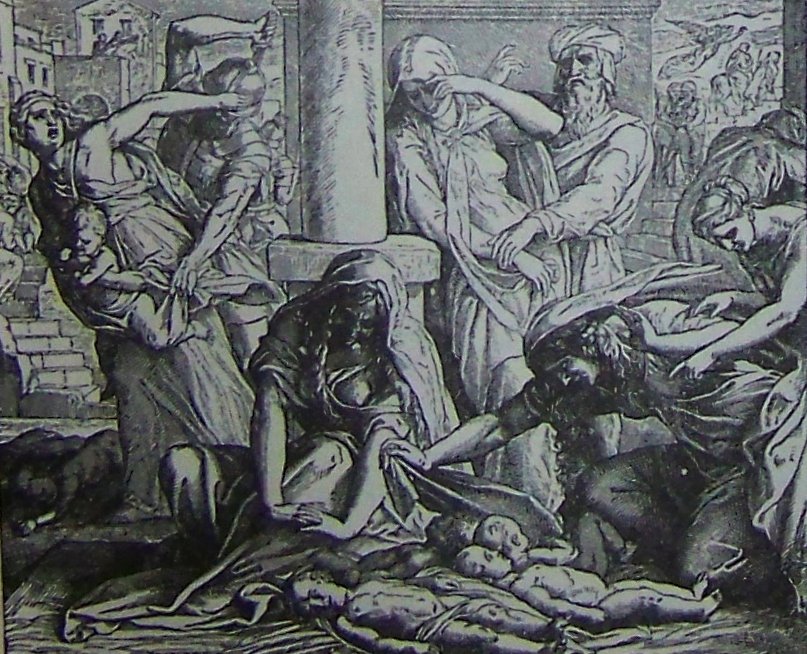
the Lord struck down all the firstborn sons in the land of Egypt, from the firstborn son of Pharaoh, who sat on his throne, to the firstborn son of the prisoner in the dungeon. Even the firstborn of their livestock were killed. Pharaoh and all his officials and all the people of Egypt woke up during the night, and loud waiting was heard throughout the land of Egypt. There was not a single house where someone had died.
This act of horror needs no additional comment.

After that, Pharaoh kicked the people of Israel out of Egypt. He asks Aaron and Moses to bless him as they leave. Even if the God of the Israelites is a genocidal monster, he is still a powerful being.

We also get a couple descriptions of how the Israelites should observe Passover, including three or four repetitions of the command not to eat yeast during that time. I guess that part was important.

Inspired by commenter big-bad-al, it's math time!
  • Number of men to leave Egypt with Moses and Aaron: 600,000 (Exodus 12)
  • Time the Israelites had been in Egypt: 430 years
  • Genealogy of Moses and Aaron: Levi (137 at death), Kohath (133 at death), Amram (137 at death) (Exodus 6)
  • Ages of Moses and Aaron when they started making demands from Pharaoh: 80 and 83 respectively (Exodus 7)
  • Number of Israelite men to originally go to Egypt: 70 (Genesis 46)
So, first, let's look at the claim that that the Israelites spent 430 years in Egypt.
  • Levi must have been at least 40 when he came to Egypt. 
    • Levi was Joseph's older brother
    • Joseph was 30 when he started serving Pharaoh, and it was 9 more years before his family came to Egypt (seven years of plenty plus the first two years of famine)
    • Plus Levi is older than Joseph. There are 7 brothers between them.
    • He was probably more like 50 since there were 7 brothers (by several mothers) between Levi and Joseph.
  • If Kohath was born in Egypt, he could have been born at most 97 years after the Israelites came to Egypt
    • Assuming Levi came to Egypt at age 40 and had Kohath when he died at age 137
  • Thus, the time between Levi coming to Egypt and the exodus was at most 97 + 133 + 137 + 80 years = 447 years. We are okay so far.
  • Of course, that's making the unlikely assumption that all the men had the relevant child at the end of their life. Remember, Abraham was laughably old when he had Isaac at age 100.
  • But oops!  We're being too optimistic. According to Genesis 46, Kohath was one of the 70 who went to Egypt with Jacob.
  • Assuming he was an infant, that makes for a maximum of 133 + 137 + 80 = 350 years between the Israelites coming to Egypt and the exodus. 80 years short of the needed 430.
Now let's look at the population growth.
  • To get from 70 men to 600,000 would require the population to double about 13 times, or about every 33 years.
  • How many male children would each man have had to had survive to adulthood to achieve that? Well, it depends on the number of generations.
    • 3 generations: 20.5, 4 generations: 9.6, 5 generations: 6.1, 6 generations: 4.5
  • Now, if we factor in the fact that about half the children a women has are children and a 40% child mortality rate, we get that each woman must have had this many children:
    • 3 generations: ~70, 4 generations: ~32, 5 generations: ~20, 6 generations: ~15
  • Does this seem reasonable? Well, it depends on how strictly you interpret God's proclamation to Abraham "In the fourth generation your descendants will come back here" and what you consider a generation.

New Testament

Jesus' disciples find a colt of a donkey for him to ride into Jerusalem. This supposedly fulfills another prophecy.
Tell the people of Jerusalem,
"Look, your King is coming to you.
He is humble, riding on a donkey—
riding on a donkey's colt"
This comes from Zechariah 9:9. Let's look at the original.
Rejoice, O people of Zion!
Shout in triumph, O people of Jerusalem!
Look, your king is coming to you.
He is righteous and victorious,
yet he is humble, riding on a donkey—
riding on a donkey’s colt.
Interesting omission, leaving out the "righteous and victorious" part. It also does not reflect well on this prophecy that the original context has the king coming after a series of military victories.

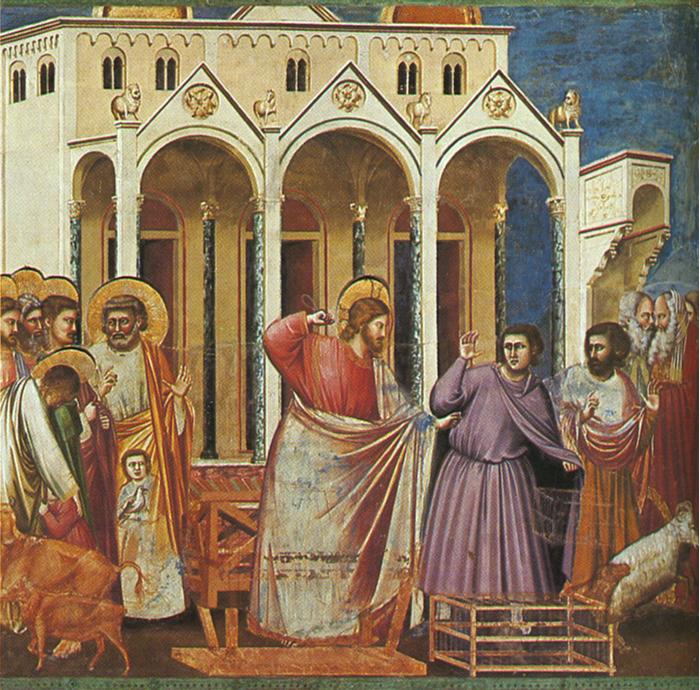
Jesus then kicks the money changers and sellers of sacrifice animals out of the temple and starts healing from the temple. Today we also read about Jesus cursing a fig tree. See, Jesus was hungry, but this fig tree did not have any figs. So he cursed it and it withered up in front of him. This shows Jesus' power, but it also shows the temper we have seen flare up many times in the Book of Matthew.

Psalms and Proverbs

The psalmist continues to have troubles and continues to want to be delivered from them. The proverbs teach us that wicked people are constant liars who plot evil and constantly stir up trouble.

30 January 2010

Jan 30

Reference links:
Old Testament

Today we read about plagues eight and nine and the preparation for plague ten. If you are interested in comparing the plagues, I recommend you take a glance at this table of the plagues on Wikipedia. For each plague, it tells, amongst other things, whether there was a warning (yes on 7/10), whether or not the Israelites were spared (yes on 5/10), and who hardened Pharaoh's heart (God 4/10, passive voice 4/10, Pharaoh 2/10).

I discussed God and his hardening of Pharaoh's heart yesterday, but I must point out what God says today in preparation for the plague of locusts.
I have made [Pharaoh] and his officials stubborn so I can display my miraculous signs among them. I've also done it so you can tell your children and grandchildren about how I made a mockery of the Egyptians and about the signs I displayed among them -- and so you will know that I am the Lord.
All of this death and destruction, all of this carnage, happens because God wants to make a mockery of the Egyptians. I have to say that as someone who does not assume a priori that this God is a loving God this sounds disgusting. Positively, undeniably disgusting.

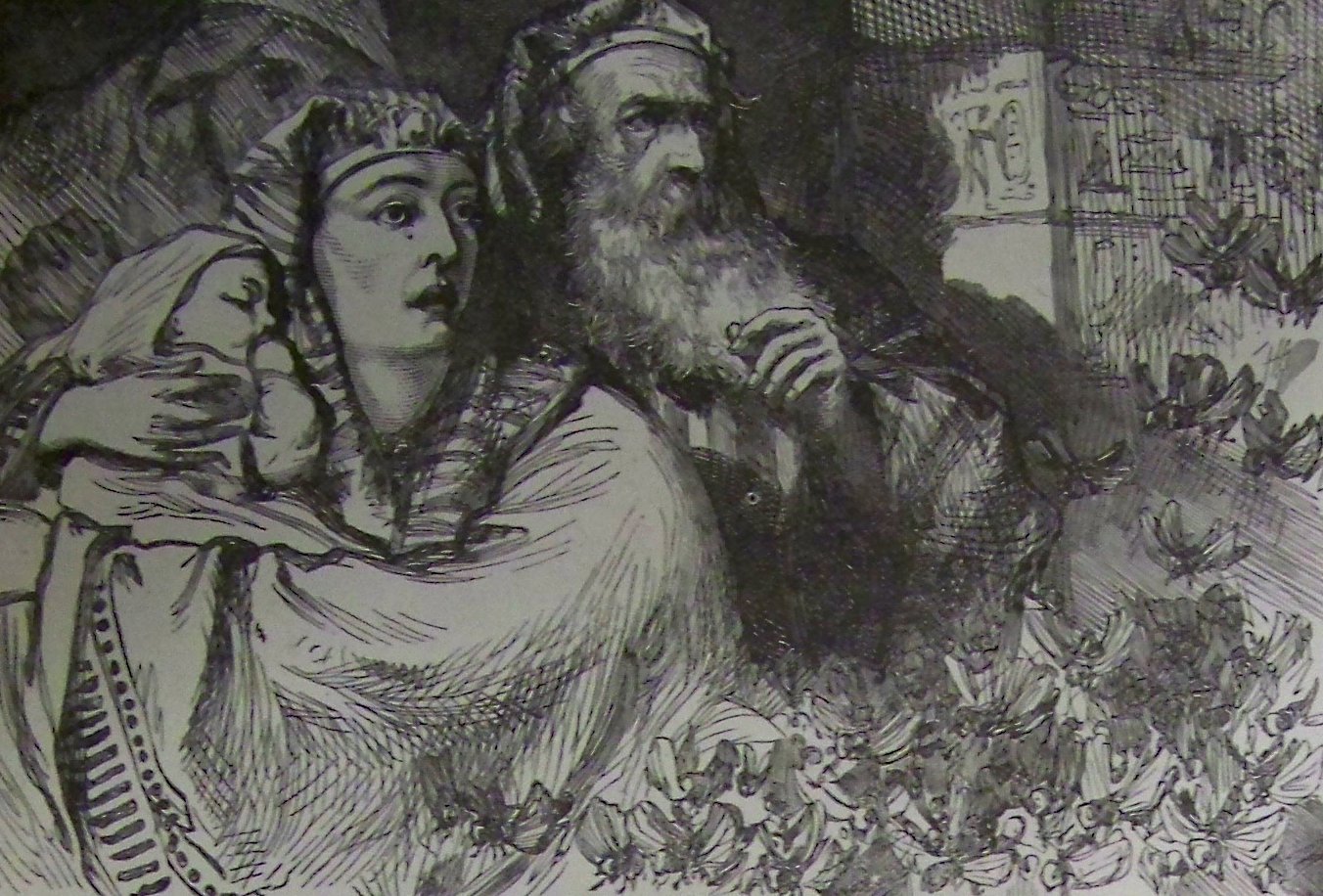
Pharaoh almost gives in to the threat of the locusts. He says that he will let the men of Israel go and worship but not the women or children, and he will not let them take the livestock. Clearly, Moses' lie about just wanting to go worship appears as obvious to Pharaoh as it does to those of us who read the account of Moses' initial exchange with God. Because Pharaoh will not agree to letting all the Israelites go, God calls locusts down upon the land.

Pharaoh begs Moses to take the locusts away. Moses does so. Pharaoh goes back on his promise to let the Israelites go, and so we get the ninth plague: the plague of darkness. God covered Egypt with "a darkness so thick you can feel it."  To get rid of the darkness, Pharaoh offered to let all the Israelites go worship their God, but would not allow them to take any animals. Moses does not accept that.

God and Moses plot the final plague. The plan was for this plague to cause the Egyptians to be happy to get rid of the Israelites. Moses told the people of Israel to ask their Egyptian neighbors for gold and silver. The Egyptians would give it because
the Lord had caused the Egyptians to look favorably on the people of Israel. And Moses was considered a very great man in the land of Egypt, respected by Pharaoh's officials and the Egyptian people alike.
I  wonder if something was lost in translation here. I cannot believe that the Egyptians looked favorably upon the people of Israel. Fear or awe I would buy, but favor? Not likely.

God says that he will kill the firstborn of every family "Even the firstborn of all the livestock." Very odd that will kill the firstborn of all the livestock given that all the livestock were supposedly killed in the fifth plague. From Exodus 9:6
And the Lord did just as he had said. The next morning all the livestock of the Egyptians died, but the Israelites didn’t lose a single animal. 
Preparation for this slaughter gave rise to the tradition of Passover. Each family was to kill an animal and smear its blood on the door of their home to indicate to God that he should kill no one in that home. I guess the purpose of this must be to make sure that the Israelites are obedient. Certainly God would not need the blood to know which homes belonged to the Israelites.

New Testament

Today's reading contains the parable of the vineyard workers. A landowner goes out in the morning and hires a bunch of people to work in his field. He does the same thing again throughout the day. At the end of the day, he pays all the men a full day's wage regardless of how long they worked. Now, as an analogy to heavenly rewards, I am sure this provides all sorts of insight and comfort (does not matter how long you have been a believer as long as you came when you were called, blah blah etc.).

However, from an economic perspective, it makes not one bit of sense; the analogy only works if you assume there is only one ultimate pay day. It is not a sustainable economic position. As the landowner points out, he can legally choose to pay all workers the same amount regardless of how long they work, but it his scheme will quickly destroy moral. Workers will try to get hired at the end of the day, or they will not work as hard during the day knowing that they get the full days wages anyway. One thing I am learning as I read the Bible: do not go to it for management advice.

Psalms and Proverbs

Today's psalm is another where David asks God not to let his enemies conquer him. It has a good line though.
Remember, O Lord, your compassion and unfailing love
Given the slaughter the current Exodus readings contain, it certainly seems like God need to be reminded of his compassion and love. Beyond repeated claims in the Psalms that God does have unfailing love, have we seen God's love so far? For particular individuals perhaps, but not in any general sense. Unless you say that God showed his "love" by not killing all of humanity in the flood, just most of it.

In Proverbs we learn to
Take a lesson from the ants, you lazybones.
Learn from their ways and become wise!
Though they have no prince
or governor or ruler to make them work,
they labor hard all summer,
gathering food for the winter.
Now I will admit to some confusion. In Matthew 6 Jesus said,
That is why I tell you not to worry about everyday life—whether you have enough food and drink, or enough clothes to wear. Isn’t life more than food, and your body more than clothing? Look at the birds. They don’t plant or harvest or store food in barns, for your heavenly Father feeds them. And aren’t you far more valuable to him than they are? Can all your worries add a single moment to your life?
So which should I be like, the industrious ants or the carefree and trusting birds? Maybe I should just be human, able to balance work and pleasure as appropriate. Able to prepare for winter without forgoing the joy of summer.