29 January 2010

Jan 29

Reference links:

Old Testament

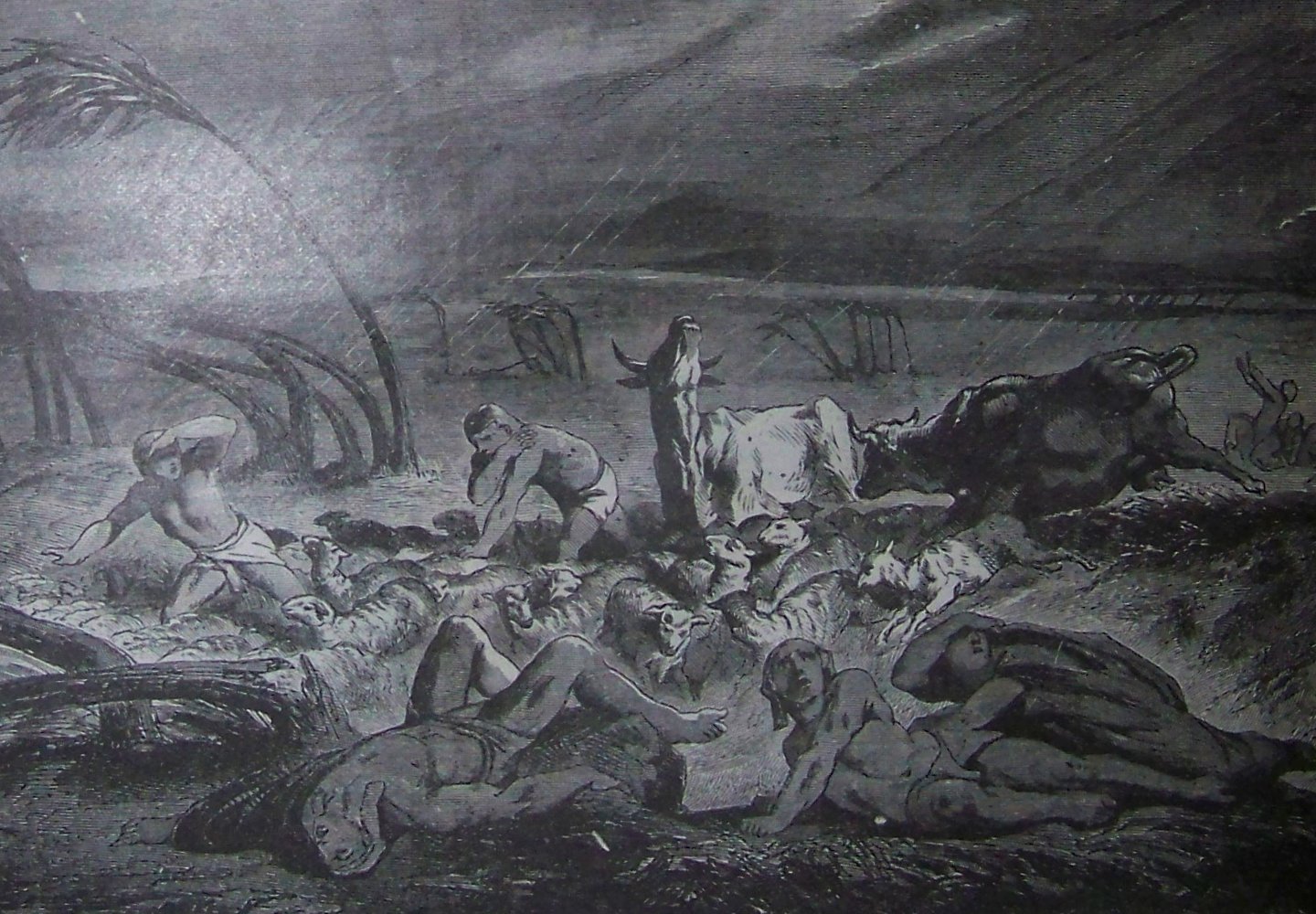
Plagues, plagues, nothing but plagues. At least there are lots of good pictures to show the vast amounts of human suffering that a supposedly loving God was willing to subject the Egyptian people to (and certainly some of them were innocent of evil against the Hebrews).
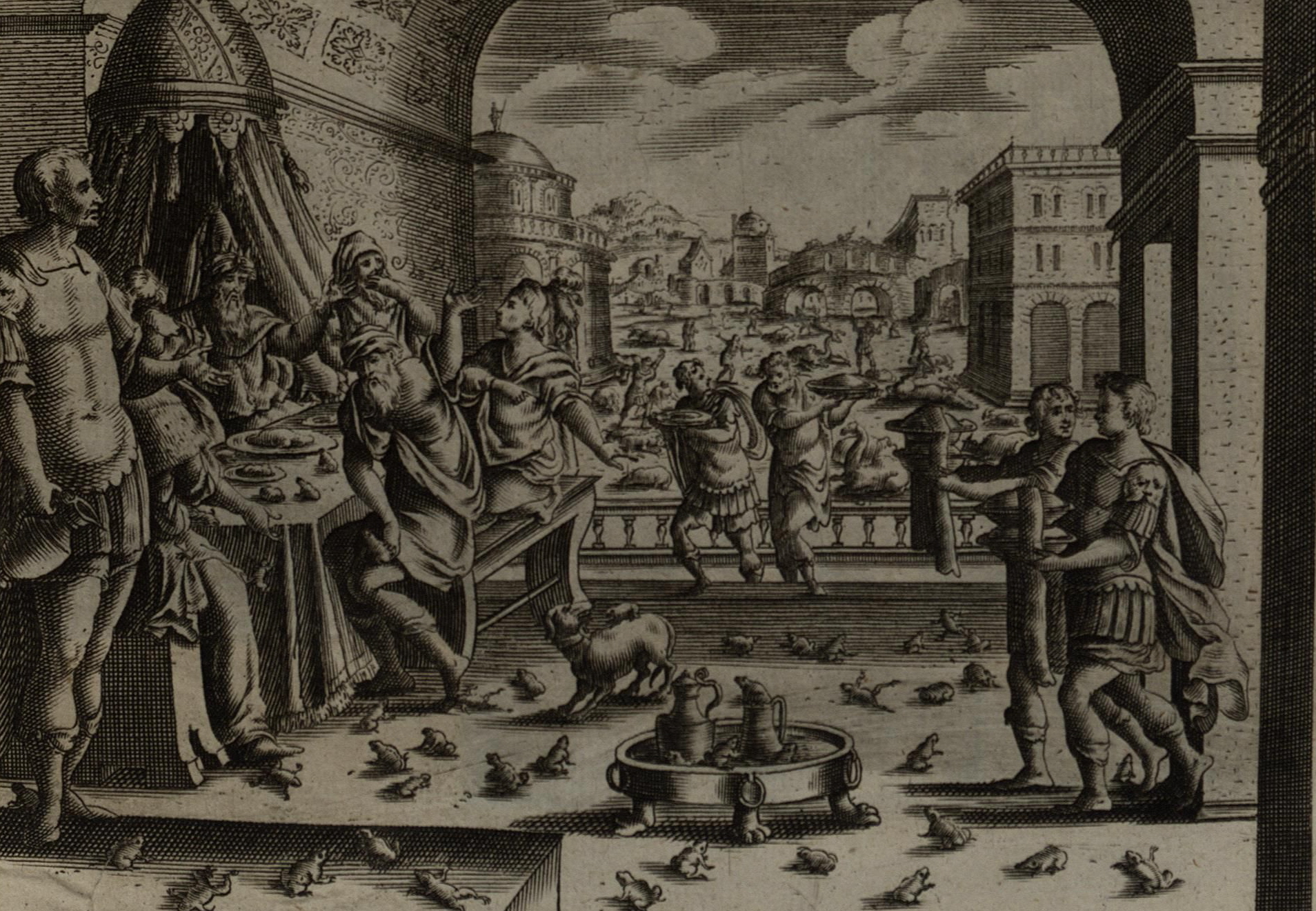
First, frogs. I am sure a plague of frogs would cause a lot of damage, but I cannot help but giggle at the description.
I will send a plague of frogs across your entire land. The Nile River will swarm with frogs. They will come up out of the river and into your palace, even into your bedroom and onto your bed! They will enter the houses of your officials and your people. They will even jump into your ovens and your kneading bowls. Frogs will jump on you, your people, and all your officials.
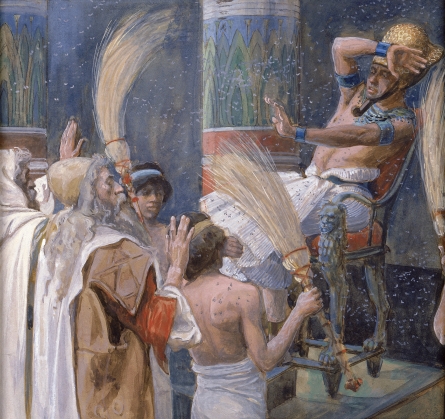
After frogs, God plagues Egypt with gnats. All of the dust in the land was turned to gnats. At this point, in addition to the very serious problem of gnats, the Egyptians are probably experiencing significant structural stability problems; a sizable chunk of the ground in a desert country could be considered dust. The plague of gnats also has the distinction of being the first plague Pharaoh's magicians cannot duplicate. This leads them to say that this event must be from God. The magicians have a pretty high opinion of their skills if they figure that anything they cannot do must be God's doing.

Next, flies. To show his power, this time God spares the region of Goshen where the Hebrews live. Yes, this time. Apparently the first few plagues afflicted the people of Israel as well as the people of Egypt. The people of Israel probably hated Moses even more after that.

After that, God sends a deadly plague against all of the Egyptian's livestock and killed it all. Next God sends a plague of festering boils. But Pharaoh still will not relent. However, this time we learn a bit more about the nature of Pharaoh's intransigence:
But the Lord hardened Pharaoh's heart, and just as the Lord had predicted to Moses, Pharaoh refused to listen.
Why would the Lord do that?
By now I [the Lord] could have lifted my hand and struck you and your people with a plague to wipe you off the face of the earth. But I have spared you for a purpose -- to show you my power and to spread my fame throughout the earth.
The plagues are a power trip. He could have just done something to enable the Hebrews to leave Egypt (something equally violent, I am sure, but less sadistically drawn out). Instead, he wants his reputation as a cruel and powerful being to spread throughout the earth. I guess it has, but somehow people have been fooled into thinking that his violent murderous ways are "good" and "love".

Oh yeah, and God sent a bunch of hail which left all of Egypt in ruins and killed everything and everyone that was out in it. But Pharaoh still refused to change his mind.

Another thing I noticed: each time Moses asks Pharaoh to let them go, he asks the Pharaoh to let the Hebrews go temporarily so that they can worship God in the wilderness. However, we know from Moses' earlier conversation with God in the burning bush that really the goal is to get the Hebrew people back into the land of Canaan. Rather deceptive of Moses, in my opinion.

New Testament

Jesus blesses children. The Kingdom of Heaven belongs to people who are like children. It's hard for rich people to get into heaven because they do not want to give up their stuff. The twelve disciples will judge the twelve tribes of Israel in heaven.

Psalms and Proverbs

Nothing particularly noteworthy in the Psalms today. Proverbs teaches us not to guarantee a friend or stranger's debt. If you find your self in such a situation,
Now swallow your pride;
go and beg to have your name erased.

Don't put it off; do it now!
Don't rest until you do.

Save yourself like a gazelle escaping from a hunter,
like a bird fleeing from a net.
Good advice. Money lending between friends can be a huge source of problems. Better to just give what you can in ways that you do not expect to have repaid (whether that be a gift of money or other forms of help).

28 January 2010

Jan 28

Reference links:

Old Testament

Yesterday, Moses tried to get Pharaoh to let the people of Israel go worship their God, failed, and got everyone angry at him. Today, Moses points that out to God. God goes on about how he is the God of the people of Israel and remembers his covenant. God's tone suggests he might be getting impatient with Moses.
You can be sure that I have heard the groans of the people of Israel, who are now slaves to the Egyptians. And I am well aware of my covenant with them.
Of course, my reading may be biased. I always read the phrase "well aware" in a tone that implies frustration

Moses and Aaron meet with the people of Israel again, but they no longer want to listen. According to the text
They had become too discouraged by the brutality of their slavery.
Another way to read this: the people of Israel know that Moses and Aaron's interference increased their workload once. This makes them reluctant to listen to the two of them again.

Genealogy break! We get the genealogy of some of the clans of Israel. Nothing too exciting, but we do learn that Levi lived to be 137, his son Kohath lived to be 133, and Kohath's son and Moses' father Amram lived to be 137. Also of note is that Moses is the great grandson of Levi and Moses' mother was his father's aunt.

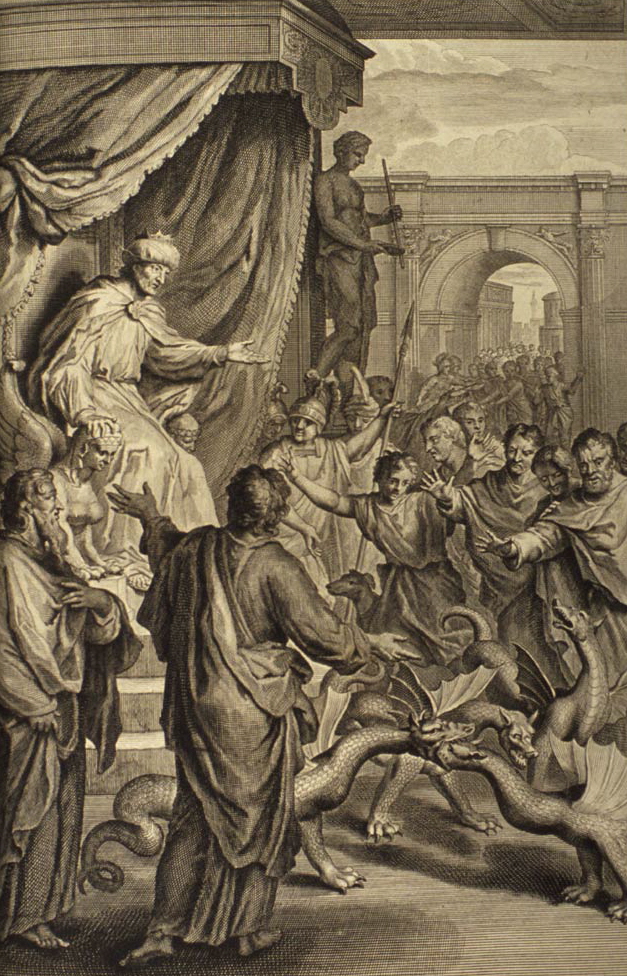
Moses and Aaron go and show Pharaoh their stuff. First, Aaron turns his staff into a snake (one is led to wonder why he did not try that trick in the first meeting given that God had already given Moses the ability to do so). However, Pharaoh scoffs at the trick because his magicians come and do the same thing with their staffs (and Aaron's snake eats up theirs). I could accept that God gave Moses and Aaron the ability to turn their staffs into snakes. However, this story claims that the Egyptian magicians were capable of the same thing. Since I do not believe that people can go around turning staffs into snakes, this story makes me think more that the Biblical author and audience were superstitious (by modern standards). This, in turn, makes me that much more skeptical of any of the other miraculous events described.

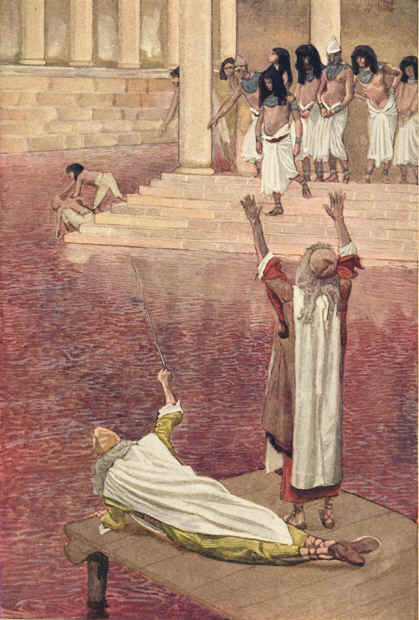
Moses and Aaron's next turn the water of the Nile to blood. Real blood, or, at least, something toxic enough to kill all the fish. And not just the water in the Nile, God told Moses to tell Aaron to
Turn all the water to blood. Everywhere in Egypt the water will turn to blood, even the water stored in wooden bowls and stone pots.
However, the Pharaoh was not impressed. His own magicians did the same thing (one wonders where they got the water since Aaron was supposed to have turned all of it to blood). We then read that,
Pharaoh returned to his palace and put the whole thing out of his mind.
Really? Really?!? All of the water in his country has been turned into toxic, reeking blood, and Pharaoh just goes back to his palace and forgets about it? Even if he does not care about the people of Egypt, he almost certainly has a sense of self preservation and would be worried that he no longer has any water to drink.

New Testament

People should be forgiving because God forgives us even more. A man should not be allowed to divorce his wife unless she has committed adultery. Also, people should avoid marriage if they can
Jesus' disciples then said to him, "If this is the case, it is better not to marry!"

"Not everyone can accept this statement," Jesus said. "Only those whom God helps. Some are born as eunuchs, some have been made eunuchs by others, and some choose not to marry for the sake of the Kingdom of Heaven. Let anyone accept this who can. [emphasis mine]
And I would guess that a lot more Christians could accept not being married than do accept it.

Psalms and Proverbs

Today's psalm is a famous one. It also is the first thing I have read in the Bible makes it an attractive basis for a belief system. It the whole Bible had the tone of this psalm, then I would be a lot less inclined to dismiss the Bible as a primitive collection of myths and history.
The Lord is my shepherd;
I have all that I need.
He lets me rest in green meadows;
he leads me beside peaceful streams.

He renews my strength.
He guides me along right paths,
bringing honor to his name.

Even when I walk
through the darkest valley,
I will not be afraid
for you are close beside me.
Your rod and your staff
protect and comfort me.

You prepare a feast for me
in the presence of my enemies.
You honor me by annointing my head with oil.
My cup overflows with blessings.

Surely your goodness and unfailing love will pursue me
all the days of my life,
and I will live in the house of the Lord
forever.
This psalm also highlights the fact that that the New Living Translation sucks when it comes to Biblical poetry. The translation has greater accuracy than the King James version, and it is more comprehensible to modern readers, but
Even when I walk through the darkest valley, I will not be afraid 
 has nothing on
Yea, though I walk through the valley of the shadow of death, I will fear no evil

27 January 2010

Jan 27

Reference links:

Old Testament

As I was washing dishes this evening, I realized how odd it is that none of the Pharaohs that the Hebrews interact with are named. They are always referred to as "Pharaoh" or "king of Egypt". Given that Egypt is well documented for an ancient society, the stories in Egypt would be more believable if the Pharaohs were named.

Moses, being a sensible man, realizes that he cannot expect the people of Israel to believe that he is speaking for God just because he says so. Whatever his personal experience might have been, he cannot transfer that experience to other people. He makes this point to God, and God gives him the ability to turn his staff into a snake, make his hand diseased and healed again, and turn water of the Nile into blood.

Moses next protests that he cannot speak well. God has an answer for that,
Who makes a person's mouth? Who decides whether people speak or do not speak, hear or do not hear, see or do not see? Is it not I, the Lord? Now go! I will be with you as you speak, and I will instruct you in what to say.
Some early Biblical descriptions of God make him responsible for misfortune as well as good; this passage supports that view, at least with respect to some types of misfortune. Whether you take this physically (God makes people blind) or metaphorically (God keeps people from understanding), this passage seems at odds with the idea of a God of love. That said, a God responsible for both good and evil is more consistent withthe view of God as omnipotent and the creator of all.

In any case, God agrees to let Moses get help from his brother Aaron. Given that Pharaoh declared that all Hebrew boys should be murdered at birth, I wonder where Aaron came from. What he born before the decree? After it was lifted? Did Moses' mother hide a second child? Was Aaron actually Moses' brother-in-law? No clue.


After finishing up his conversation with God, Moses, his wife, and their sons leave Midian for Egypt. On the way something very strange happens.
On the way to Egypt, at a place where Moses and his family had stopped for the night, the Lord confronted him and was about to kill him. But Moses' wife, Zipporah, took a flint knife and circumcised her son. She touched his feet with the foreskin and said, "Now you are a bridegroom of blood to me." (When she said "a bridegroom of blood," she was referring to the circumcision.) After that, the Lord left him alone.
Okay... Apparently God changes his mood as quickly as Jesus (so there is a family resemblance!). Moses had just been talking to God. Now God tries to kill him. Maybe God had a good reason, but it seems extreme. And weird. I would expect that if God tried to kill someone, he would succeed. Also, good call on Zipporah's part figuring out (somehow) that a rapid and probably somewhat imprecise circumcision would appease God.

Aaron and Moses meet up, go to Egypt, convince the elders of Israel they are speaking for God, talk to Pharaoh, Pharaoh refuses to let the people leave to worship God. Then, Pharaoh commits a management snafu. He assumes that since the people have the will to ask for things, they must lack work. Pharaoh gets the great idea of making them find their own straw for their bricks without reducing the number of bricks expected of them. I guess slave drivers cannot be expected to have a great understanding of people management.

New Testament


Today, the disciples ask "Who is the greatest in the Kingdom of Heaven?" Jesus replies that those who make themselves like a humble child are the greatest in the Kingdom of Heaven.

Today, we also read about Jesus' (hopefully metaphorical) recommendation of self mutilation.
What sorrow awaits the world, because it tempts people to sin. Temptations are inevitable, but what sorrow awaits the person who does the tempting. So if your hand or foot causes you to sin, cut if off and throw it away. It's better to enter eternal life with only one hand or one foot than to be thrown into eternal fire with both of your hands and feet. And if your eye causes you to sin, gouge it out and throw it away. It's better to enter eternal life with only one eye than to have two eyes and be thrown into the fire of hell.
A couple of lessons. Believers should avoid things that might tempt them to sin (hopefully you won't take that to mean that you should stop reading my blog!). Also, either your physical body enters heaven or hell, your spiritual body reflects the state of your physical body, or this passage is completely metaphorical.

We also learn today that
if two of you agree here on earth concerning anything you ask, my Father in heaven will do it for you. For where two or three gather together as my followers, I am there among them.
It is not completely clear who Jesus is addressing here. He could just be addressing the disciples. However, the preceding passages seemed to be addressed to believers generally. Furthermore, the passage says "where two or three gather together as my followers" without any qualification. If the passage is referring to all believers, it is problematic. What if different groups of two or three believers get together and ask for contradicting things? How do we to account for all of the things asked for by groups of believers that do not come to pass? This passage specifically says that if the believer agree concerning anything they ask, God will do it for them.

Psalms and Proverbs

Nothing particularly noteworthy in today's reading from Psalms. We do have some good lines in Proverbs today. Rather racy.
Drink water from your own well --
share your love only with your wife.
Why spill the water of your springs in the streets,
having sex with just anyone?
You should reserve it for yourselves
Never share it with strangers.

Let your wife be a fountain of blessing for you.
Rejoice in the wife of your youth.
She is a loving deer, a graceful doe.
Let her breasts satisfy you always.
May you always be captivated by her love.
Still, as entertaining as those lines are, I sometimes tired of the way Proverbs seems to always address men.

26 January 2010

Jan 26

Reference links:
Old Testament

Moses murders a man! Moses went to visit his people, and he saw a Egyptian beating a Hebrew man. Moses murdered the man and hid his body in the sand. Next day, Moses visits his people again, and it comes out that people know he had murdered the Egyptian. In response, Moses flees.

He flees to Midian, where he helps protect a group of shepherdess sisters from harassment by the local yokels. Reuel, the father of the girls, invites Moses to stay with them. Moses settles down with the family, and eventually marries Reuel's daughter Zipporah. Not bad for a courtship story, but it lacks the level of detail which makes Jacob's courtship or Isaac's courtship by proxy compelling.

Years later, while Moses tends the sheep of his father-in-law Jethro, he leads the flock to Sinai, "the mountain of God". At Sinai, God talks to Moses from a bush.

Now wait a second, did you see what I tried to pull on you there. First, I say that Moses' father-in-law is Reuel, then I say his name is Jethro. The Bible tries the same thing. In Exodus 2 we see the following references to Reuel.
When the girls returned to Reuel, their father ...
In time, Reuel gave Moses his daughter Zipporah to be his wife .
Then, at the beginning of Exodus 3 we read
One day Moses was tending the flock of his father-in-law, Jethro, the priest of Midian
For this apparent change of name, the New Living Translation gives the following textual note
Moses' father-in-law went by two names, Jethro and Reuel
That answer fails to satisfy. Wikipedia does a little better,
It has been suggested that Reuel was his proper name, and "Jether" or "Jethro" was his official title (i.e., "excellency").
That is somewhat feasible, but it still seems like something of a stretch. Neither the text itself nor anything that could be referenced seem to be anything indicating that this usage was common.

In any case, back to the bush. The bush is burning, but it is not being consumed. God talks to Moses from the bush. Pretty cool! You notice how back in the day when God wanted to get thing done he did not bother with placing ambiguous messages in your heart? God would chat with Abraham in person, and with Isaac, Jacob, and Joseph in dreams. Even when God used symbolic dreams, like with Pharaoh, he was considerate enough to make sure there was someone like Joseph around to interpret them. And today, God talks through a burning bush. One has to wonder why God apparently cannot be so direct now.

God tells Moses that he is aware of the problems in Egypt and has decided to rescue his chosen people and lead them back to the of Canaan, the "land flowing with milk and honey". Moses and God have a bit of an exchange about God's name. Then God tells Moses that the elder's of Israel will accept his message, but Pharaoh will not let the Hebrew people go. God promises to raise his hand against the Egyptians and help the Hebrew people obtain all the wealth of the Egyptians.

New Testament

Jesus goes on about how John the Baptist was Elijah returned. Possibly interesting if you care about whether or not Jesus fulfills Messianic prophecies. Rather dull if you do not.

Then we get onto more exciting things. Jesus' disciples were unable to heal a boy, so he is brought to Jesus. Jesus lectures his disciples about their lack of faith. Apparently, with even a little faith, you can move mountains. We also hear a little about what Jesus thinks of humanity. Contrary to what some of his modern day followers would have you believe, it is not always positive.
You faithless and corrupt people! How long must I be with you? How long must I put up with you?
Jesus was not so big on his followers, apparently. Remember, these are people who have faith in him, but just not enough to extract demons or move mountains. So remember, if your faith in Jesus is not strong enough to allow you to move mountains, he may very well be wondering how long he will have to put up with you.

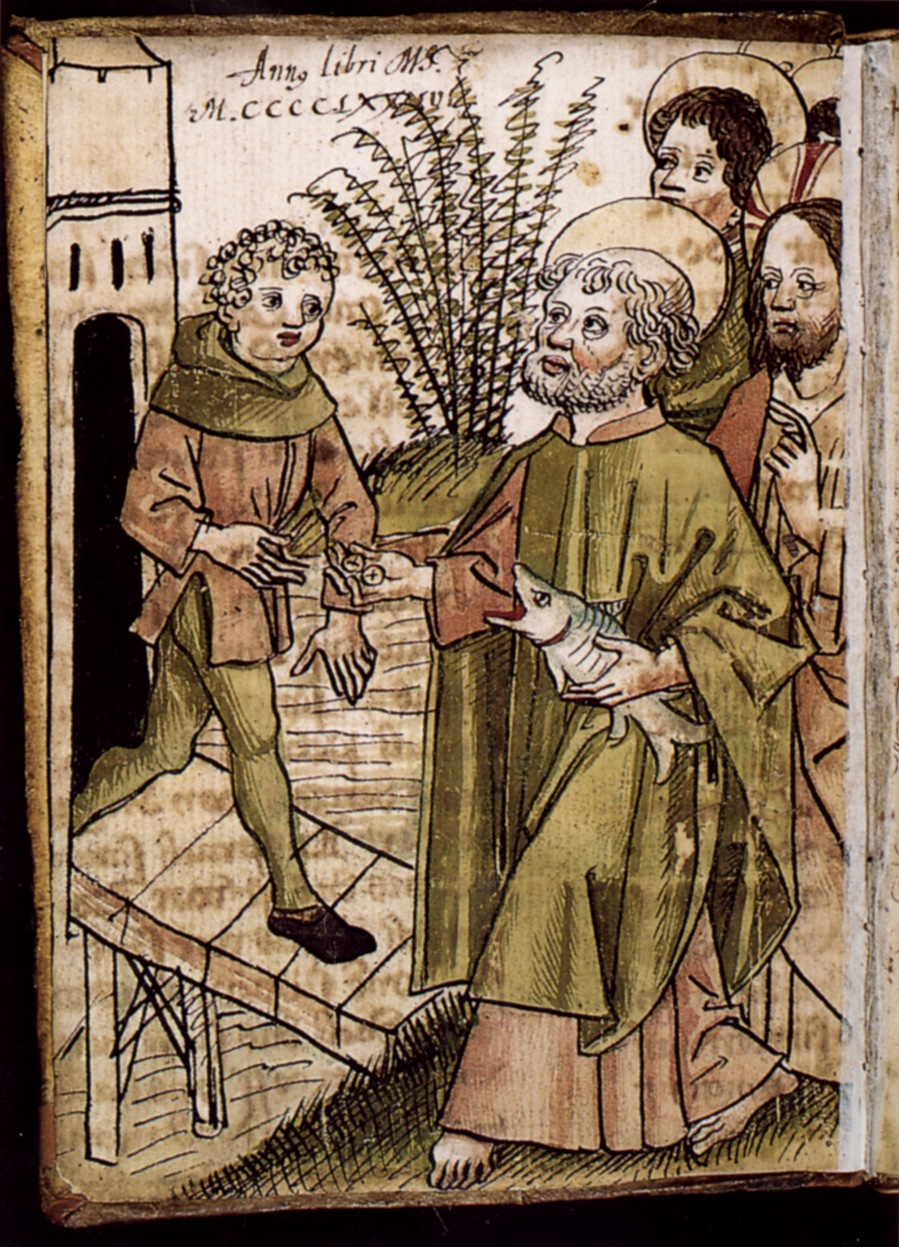
Today, we also read about Jesus' opinion of the Temple tax. The short version is that he and his followers do not have to follow it, but Jesus decides to pay it anyway because Peter had told the tax collectors that they would. Peter finds the money to pay the taxes in the mouth of a fish. Not particularly profound, but I am amused by the idea of getting money from a random fish.

Psalms and Proverbs

Today's psalm, psalm 22, is a famous one. In particular, it is the one that Jesus quotes on the cross,
My God, my God, why have you abandoned me?
It is also the one that is claimed to be a prophecy of Jesus' death on the cross. But we will leave that commentary for when we get to the crucifixion. Even without that association, this psalm is pretty grim.
My life is poured out like water,
and all my bones are out of joint.
My heart is like wax,
melting within me.

My strength has dried up like sunbaked clay.
My tongue sticks to the roof of my mouth.
...
I can count all my bones.
 Sounds miserable.

25 January 2010

Jan 25

Reference links:

Old Testament

End of Genesis and start of Exodus today. Joseph has Jacob embalmed. A great procession is formed and he is taken back to Canaan and buried with his ancestors. One slight oddity, Joseph asks Pharaoh's advisers to ask Pharaoh to let him leave to bury his father. If Joseph is second only to Pharaoh, why does he go through intermediaries?

Joseph dies too at age 110. Finally, someone who lived less than 120 years. Joseph,
lived to see three generations of his son Ephraim, and he lived to see the birth of the children of Manasseh's son Makir, whom he claimed as his own.
Joseph adopted his son's children as his own just like Jacob adopted Joseph's children as his own. Very confusing family relations there. Before he died, Joseph made his family promise to take his bones back with them when they finally left Egypt.

Now for Exodus. First thing to note, from the Wikipedia article,
More than a century of archaeological research has discovered nothing which could support the narrative elements of the book of Exodus - the four centuries sojourn in Egypt, the escape of well over a million Israelites from the Delta, or the three months journey through the wilderness to Sinai. The Egyptian records themselves have no mention of anything recorded in Exodus, the wilderness of the southern Sinai peninsula shows no traces of a mass-migration such as Exodus describes, and virtually all the place-names mentioned, including Goshen (the area within Egypt where the Israelites supposedly lived), the store-cities of Pithom and Rameses, the site of the crossing of the Red Sea, and even Mt Sinai itself, have resisted identification. The archaeology of Palestine has equally failed to substantiate the Bible's account of the invasion of Canaan by the Israelites arriving from Egypt some forty years later - of the 31 cities supposedly conquered by Joshua, only one (Bethel) shows a destruction level that equates to the Biblical narrative, and there is general agreement that the origins of Israel lie within Canaan itself. Even those scholars who hold the Exodus to represent historical truth concede that the most the evidence can suggest is plausibility.
Exodus starts off with an inconsistency (either in translation or in the source). Remember how a couple days ago we learned that Jacob's family came to 70 people, including himself. Today we read,
In all, Jacob had seventy descendants in Egypt, including Joseph, who was already there. [emphasis mine]
A new king comes to power in Egypt. He fears the strength of the people of Israel and so makes them his slaves. However, slavery did not stem the growth of the population, so Pharaoh gave an order to the Hebrew midwives, Shiphrah and Puah,
When you help the Hebrew women as they give birth, watch as they deliver. If the baby is a boy, kill him; if it is a girl, let her live.
If the number of people of Israel has really grown enough to be a threat to the people of Egypt, would they really only have two midwives? In any case, the midwives did not comply, so eventually Pharaoh made a law that all newborn Hebrew boys should be thrown into the Nile river. This is another unlikely command. The Nile was the life blood of Egypt. Would a Pharaoh with any sense really command that this river be contaminated with dead bodies?

In any case, one of the babies born is Moses. His mother puts him in a basket in the river and Pharaoh's daughter finds him. The princess sends baby Moses to nurse with his own mother. He is taken back to the princess when he is older.

New Testament

Jesus asks his disciples who he is. Simon Peter says he is the Messiah. Because of this answer, Jesus blesses him and says that he will be the foundation of Jesus' church. In addition, Jesus tells Peter
Whatever you forbid on earth will be forbidden in heaven, and whatever you permit on earth will be permitted in heaven.
This is a very odd verse. One way to interpret this would be to say that Peter is being blessed with the ability to say what is right and wrong with a way that is consistent with the decrees of heaven. However, the use of future tense almost makes it sound like Peter, through his decrees, will be changing heaven.

Jesus predicts his death and that he will be raised from the dead. Peter reprimands him for saying such things, and Jesus calls him Satan and accuses him of "seeing things merely from a human point of view, not from God's." Now, this should probably be interpreted as commentary on human knowledge and God's plans and what not. However, what I find interesting is that just after Jesus praises and blesses Peter, Jesus calls Peter Satan. I think that instead of interpreting the previous passage as Jesus giving Peter authority from God, we should interpret it as Jesus being fond of hyperbole when talking to his followers.

We also read a verse that supports the view that Jesus was a failed apocalyptic prophet. Jesus says,
For the Son of Man will come with his angels in the glory of his Father and will judge all people according to their deeds. And I tell you the truth, some standing here right now will not die before they see the Son of Man coming in his Kingdom.
Jesus has not yet come with angels to judge all people. Everyone who was alive at the time of that statement is dead. Jesus was wrong.

Today we also read about how Jesus was transformed into a much shinier version of himself and was chatting with Moses and Elijah. And then,
a bright cloud overshadowed them, and a voice from the cloud said, "This is my dearly loved Son, who brings me great joy. Listen to him."
We had a somewhat similar event in Matthew 3,
After his baptism, as Jesus came up out of the water, the heavens were opened and he saw the Spirit of God descending like a dove and settling on him. And a voice from heaven said, "This is my dearly loved Son, who brings me great joy."
Did this happen twice? Or was the author of Matthew just including multiple versions of the same event?

Psalms and Proverbs

Another psalm about war, more images of an angry God. Today's reading from Proverbs is much more interesting. We are warned that
the lips of an immoral woman are as sweet as honey,
and her mouth is smoother than oil.
But in the end she is as bitter as poison,
as dangerous as a double-edge sword.
So remember, avoid those immoral women.